Unstructured review: production document pipelines
Unstructured belongs on a production document-pipeline shortlist when a team needs broad format support, configurable partitioning, connectors, and a choice between open-source and managed paths. The decision is operational rather than cosmetic: teams must validate strategy selection, dependencies, OCR, tables, metadata, hosted data boundaries, upgrades, throughput, exceptions, and review effort on their corpus.
Continue your research in ToolVerse.
Open ToolVerse for evidence, pricing context, alternatives, and current review status. Every link below navigates to the external ToolVerse directory.
Explore AI automation tools Open on ToolVerse · externalVerdict
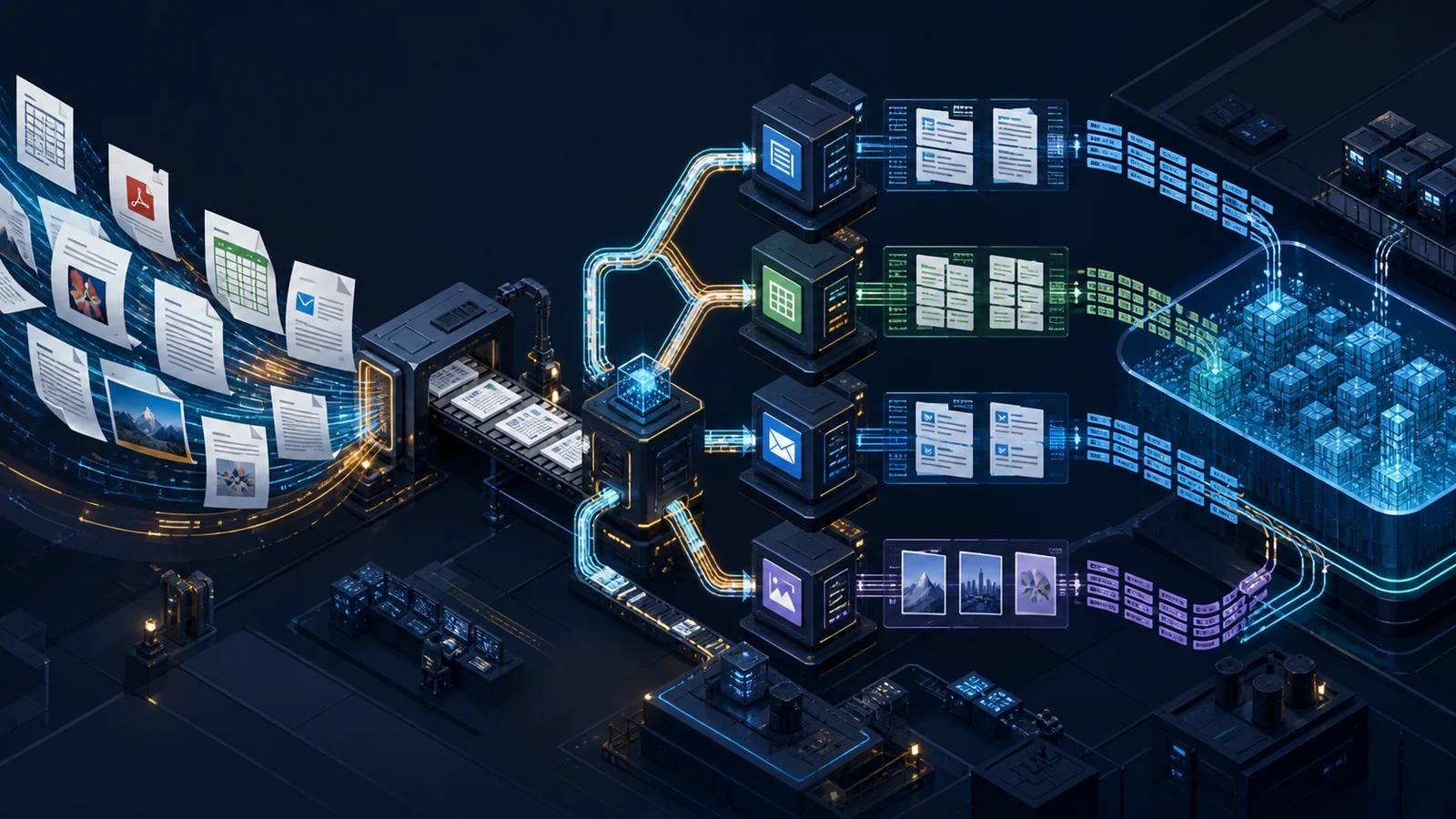
Unstructured is a document-ingestion platform and open-source library that partitions many file types into elements for downstream search and AI pipelines. Its documented strength is breadth: multiple document types, parsing strategies, metadata, chunking, connectors, and hosted or self-managed paths can be composed around an ingestion job. That makes it a legitimate shortlist candidate, not a proven default. Product facts in this review come from official documentation and the maintained project record. Community reports and independent articles are used only to identify questions a buyer should reproduce.
The decision should be framed around the artifact that leaves the pipeline. Ask whether required content is present, ordered, editable, attributable, and safe to pass downstream. The multimodal evaluation framework supplies a broader measurement frame, while this review stays specific to Unstructured.
Best fit
Unstructured best fits a team that can own its surrounding system. The buyer should have a named corpus owner, pipeline engineer, reviewer, security contact, and release authority. Those people need a shared definition of success and a queue for pages or outputs that cannot satisfy it.
Its documented strength is breadth: multiple document types, parsing strategies, metadata, chunking, connectors, and hosted or self-managed paths can be composed around an ingestion job. A strong pilot starts with narrow, consequential documents or creative outputs and expands only after failures are classified. Teams that already use the creative workflow operating model will be better positioned to distinguish a useful intermediate artifact from a polished but unverifiable result.
Not a good fit
Unstructured is a weak fit when the organization expects a product name to replace workflow design, data review, or publishing accountability. It is also a weak fit when no one can maintain dependencies, validate updates, investigate exceptions, or preserve the evidence needed to reproduce a decision.
Strategy choice, native dependencies, OCR components, model downloads, connector credentials, and hosted-versus-local boundaries create an operating surface that a quick start does not price or validate. If the business requirement is a contracted outcome with support and service levels, compare a managed provider rather than assuming an open component offers the same operating boundary.
Capabilities and documented limits
A document-ingestion platform and open-source library that partitions many file types into elements for downstream search and AI pipelines. The core repository is open source, while hosted APIs, connectors, models, and enterprise service levels have separate terms and costs.
Its documented strength is breadth: multiple document types, parsing strategies, metadata, chunking, connectors, and hosted or self-managed paths can be composed around an ingestion job. These statements describe documented surfaces, not measured results on ToolVerse files. A supported format may still contain unsupported structures; an editable export may still substitute fonts; a structured output may still omit a relationship that matters to the buyer.
Strategy choice, native dependencies, OCR components, model downloads, connector credentials, and hosted-versus-local boundaries create an operating surface that a quick start does not price or validate. Build tests around the difficult tail: scans, rotated pages, merged cells, nested tables, charts, handwriting, multilingual content, damaged files, large inputs, duplicate jobs, and outputs that should be refused. Use the document extraction quality controls to specify what enters a human queue.
Input diversity
For Unstructured, input diversity must be converted into observable evidence before procurement. Create a representative case, record the exact release and configuration, preserve the raw input, and compare the structured artifact with independently prepared expectations. A visually plausible output is not sufficient when a downstream workflow relies on table coordinates, reading order, source references, timing, or editable objects. The accountable owner should record which defects are acceptable, which require correction, and which stop the pipeline.
This lens also changes cost. Count preparation, model or API use, local compute, storage, retries, reviewer minutes, corrections, incident response, and migration work. An example pilot threshold may help a team start, but it is not an industry standard and should never be copied without a workload-specific risk decision. Unstructured should advance only when the evidence survives a version change and can be explained by someone other than the prototype author. This requirement is evaluated specifically in the Input diversity checkpoint.
Structural fidelity
For Unstructured, structural fidelity must be converted into observable evidence before procurement. Create a representative case, record the exact release and configuration, preserve the raw input, and compare the structured artifact with independently prepared expectations. A visually plausible output is not sufficient when a downstream workflow relies on table coordinates, reading order, source references, timing, or editable objects. The accountable owner should record which defects are acceptable, which require correction, and which stop the pipeline.
This lens also changes cost. Count preparation, model or API use, local compute, storage, retries, reviewer minutes, corrections, incident response, and migration work. An example pilot threshold may help a team start, but it is not an industry standard and should never be copied without a workload-specific risk decision. Unstructured should advance only when the evidence survives a version change and can be explained by someone other than the prototype author. This requirement is evaluated specifically in the Structural fidelity checkpoint.
Operational control
For Unstructured, operational control must be converted into observable evidence before procurement. Create a representative case, record the exact release and configuration, preserve the raw input, and compare the structured artifact with independently prepared expectations. A visually plausible output is not sufficient when a downstream workflow relies on table coordinates, reading order, source references, timing, or editable objects. The accountable owner should record which defects are acceptable, which require correction, and which stop the pipeline.
This lens also changes cost. Count preparation, model or API use, local compute, storage, retries, reviewer minutes, corrections, incident response, and migration work. An example pilot threshold may help a team start, but it is not an industry standard and should never be copied without a workload-specific risk decision. Unstructured should advance only when the evidence survives a version change and can be explained by someone other than the prototype author. This requirement is evaluated specifically in the Operational control checkpoint.
Review economics
For Unstructured, review economics must be converted into observable evidence before procurement. Create a representative case, record the exact release and configuration, preserve the raw input, and compare the structured artifact with independently prepared expectations. A visually plausible output is not sufficient when a downstream workflow relies on table coordinates, reading order, source references, timing, or editable objects. The accountable owner should record which defects are acceptable, which require correction, and which stop the pipeline.
This lens also changes cost. Count preparation, model or API use, local compute, storage, retries, reviewer minutes, corrections, incident response, and migration work. An example pilot threshold may help a team start, but it is not an industry standard and should never be copied without a workload-specific risk decision. Unstructured should advance only when the evidence survives a version change and can be explained by someone other than the prototype author. This requirement is evaluated specifically in the Review economics checkpoint.
Change management
For Unstructured, change management must be converted into observable evidence before procurement. Create a representative case, record the exact release and configuration, preserve the raw input, and compare the structured artifact with independently prepared expectations. A visually plausible output is not sufficient when a downstream workflow relies on table coordinates, reading order, source references, timing, or editable objects. The accountable owner should record which defects are acceptable, which require correction, and which stop the pipeline.
This lens also changes cost. Count preparation, model or API use, local compute, storage, retries, reviewer minutes, corrections, incident response, and migration work. An example pilot threshold may help a team start, but it is not an industry standard and should never be copied without a workload-specific risk decision. Unstructured should advance only when the evidence survives a version change and can be explained by someone other than the prototype author. This requirement is evaluated specifically in the Change management checkpoint.
Failure visibility
For Unstructured, failure visibility must be converted into observable evidence before procurement. Create a representative case, record the exact release and configuration, preserve the raw input, and compare the structured artifact with independently prepared expectations. A visually plausible output is not sufficient when a downstream workflow relies on table coordinates, reading order, source references, timing, or editable objects. The accountable owner should record which defects are acceptable, which require correction, and which stop the pipeline.
This lens also changes cost. Count preparation, model or API use, local compute, storage, retries, reviewer minutes, corrections, incident response, and migration work. An example pilot threshold may help a team start, but it is not an industry standard and should never be copied without a workload-specific risk decision. Unstructured should advance only when the evidence survives a version change and can be explained by someone other than the prototype author. This requirement is evaluated specifically in the Failure visibility checkpoint.
Data boundaries
For Unstructured, data boundaries must be converted into observable evidence before procurement. Create a representative case, record the exact release and configuration, preserve the raw input, and compare the structured artifact with independently prepared expectations. A visually plausible output is not sufficient when a downstream workflow relies on table coordinates, reading order, source references, timing, or editable objects. The accountable owner should record which defects are acceptable, which require correction, and which stop the pipeline.
This lens also changes cost. Count preparation, model or API use, local compute, storage, retries, reviewer minutes, corrections, incident response, and migration work. An example pilot threshold may help a team start, but it is not an industry standard and should never be copied without a workload-specific risk decision. Unstructured should advance only when the evidence survives a version change and can be explained by someone other than the prototype author. This requirement is evaluated specifically in the Data boundaries checkpoint.
Version stability
For Unstructured, version stability must be converted into observable evidence before procurement. Create a representative case, record the exact release and configuration, preserve the raw input, and compare the structured artifact with independently prepared expectations. A visually plausible output is not sufficient when a downstream workflow relies on table coordinates, reading order, source references, timing, or editable objects. The accountable owner should record which defects are acceptable, which require correction, and which stop the pipeline.
This lens also changes cost. Count preparation, model or API use, local compute, storage, retries, reviewer minutes, corrections, incident response, and migration work. An example pilot threshold may help a team start, but it is not an industry standard and should never be copied without a workload-specific risk decision. Unstructured should advance only when the evidence survives a version change and can be explained by someone other than the prototype author. This requirement is evaluated specifically in the Version stability checkpoint.
Public user-feedback themes
Community reports discuss dependency weight, PDF strategy tradeoffs, table extraction, slow ingestion in some configurations, and different results across document classes; each report remains version- and workload-specific. No single issue, post, or comment establishes prevalence. A repository issue cited in the source list is one report unless another independent report describes the same underlying behavior.
For the Unstructured production pipeline, this control has a specific implementation consequence. Across the public record, the useful recurring theme is operational variability: real results depend on file type, configuration, providers, environment, and version. That supports a stratified pilot and a locked regression set; it does not support a universal performance conclusion. Another theme is that setup convenience and artifact quality are separate. A quick conversion can still require substantial review before the result is trusted.
The Unstructured production pipeline gives this requirement a concrete operating boundary. Independent analyses are likewise contextual. Some are written by competitors and should be read with that incentive visible. They are useful for generating alternative architectures and cost questions, not for overriding current official documentation about capability, license, availability, or terms.
Cost and operational ownership
Within the Unstructured production pipeline, an accountable owner should apply this test directly. Cost includes far more than the displayed license or request price. Budget for compute, hosted services, model calls, OCR, storage, egress, observability, secrets, upgrades, regression tests, exception handling, human review, corrections, and migration. Price a verified outcome and its long-tail failures, not only a successful sample.
A Unstructured production pipeline should preserve the evidence behind this step. Assign an owner for data boundaries, service changes, release pinning, incident response, and deletion. For self-hosted paths, decide who patches images and dependencies. For hosted paths, verify data use, retention, region, subprocessors, support, quotas, and contract terms. The document platform selection discipline helps keep those ownership questions connected to downstream publication.
Alternatives
Compare OpenDataLoader PDF for a narrower PDF-first layer, Docling for another open document representation, and managed extraction APIs when a contracted service boundary is more important than component choice. Alternatives should be compared against the same corpus, output contract, reviewer instructions, and failure budget. Changing both the tool and the scoring rule makes a comparison meaningless.
The Unstructured ToolVerse profile is the reciprocal product entry point. It summarizes catalog facts; it does not replace this review or a local pilot.
Recommendation
The Unstructured production pipeline decision record should make this requirement visible. Run a time-boxed evaluation with a frozen version, representative cases, independently prepared expectations, and a defined stop rule. Record omissions, structural errors, unsupported inputs, retries, reviewer effort, and downstream effects separately. Do not collapse them into one score that hides why a result failed.
Adopt Unstructured only if the verified artifact and operating model outperform the current process on the dimensions the team actually values. Preserve a rollback path and repeat the regression set after configuration, dependency, provider, or version changes.
Methodology and limitations
For the Unstructured production pipeline, this control has a specific implementation consequence. ToolVerse reviewed the listed official, community, and independent sources on August 9, 2026. Official documentation, repositories, release records, licenses, and pricing pages control product facts. Community reports support only bounded experience themes; one issue remains one report, and a repeated theme requires independent support.
ToolVerse did not install, deploy, benchmark, or perform hands-on testing of Unstructured. It did not run a workload, reproduce a community report, inspect a customer environment, validate security or privacy, or measure quality, latency, throughput, reliability, or cost. This source-verified review provides a decision framework, not a product rating, legal opinion, compliance certification, or performance guarantee.
FAQ
What evidence should a team preserve for unstructured review?
Preserve the source version, configuration, representative input, observed output, reviewer decision, exception record, and approval that supports the release decision.
Does this review provide a universal accuracy or compliance threshold?
No. Any numeric threshold in the workflow is an example to be replaced by workload-specific acceptance criteria, risk analysis, and accountable approval.
What should teams verify immediately before adoption or release?
Recheck current documentation, availability, pricing, terms, data handling, regional rules, dependencies, and the exact production configuration because these conditions can change.