Flowise review: self-hosted AI workflows, security, and cost
Flowise is winding down: existing operators now need a migration or maintained-fork plan, while new adopters should choose an actively maintained alternative.
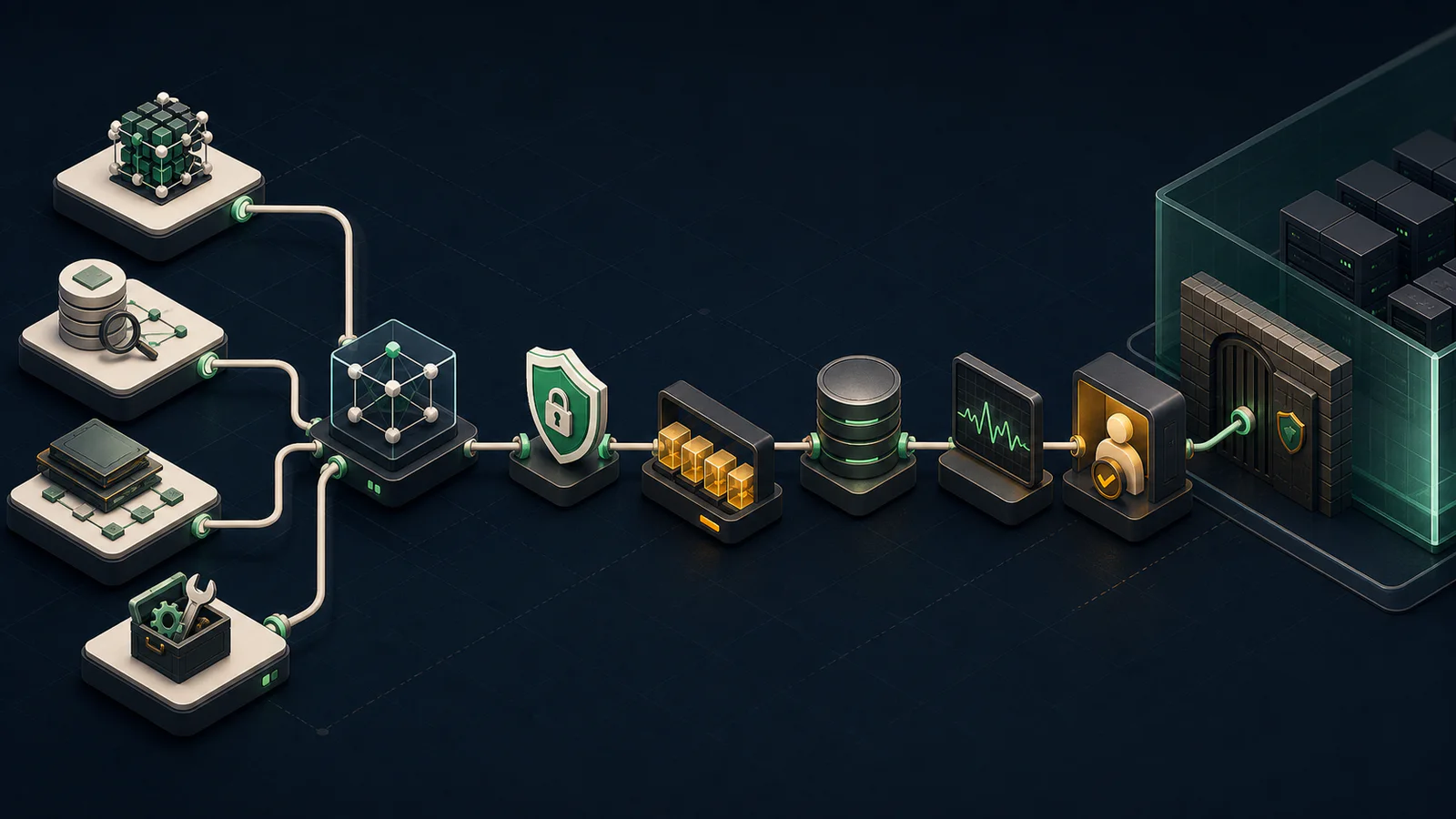
Compare the tools behind this article on ToolVerse.
Open ToolVerse for evidence, pricing context, alternatives, and current review status. Every link below navigates to the external ToolVerse directory.
Compare Flowise and Dify and Langflow Open on ToolVerse · externalBottom line
Flowise is no longer a credible candidate for a new adoption. The official Flowise team announced that development and code freeze took effect on July 27, 2026, that the public repository will be archived on August 10, 2026, and that end of life will arrive on August 31, 2026. At EOL, the core team’s Discord and GitHub presence concludes; at archival, issues and pull requests are locked and npm packages and Docker images are marked deprecated. Those milestones change the decision from product selection to migration or fork ownership.
The remaining fit is limited to existing operators who need to inventory dependencies, preserve exports, test a replacement, and decide whether to leave Flowise or maintain an accountable fork. The Apache 2.0-licensed portion of the source remains available, and the sunset notice explicitly encourages teams to fork it. A fork is not continuity supplied by the former vendor: it transfers patching, dependency updates, image and package publishing, security response, compatibility testing, documentation, support, and governance to the maintaining organization or community.
Official documentation still describes a substantial visual runtime: Agentflow, Chatflow and Assistant; model and data integrations; branching, looping, custom code, RAG indexing, memory, MCP nodes, APIs, embedded chat, execution logs, evaluations and self-hosted deployment. That capability record helps operators map what must be replaced. It does not offset the announced code freeze or create a supported roadmap for a new deployment.
This is a source-verified editorial review. ToolVerse did not install, deploy, use, benchmark, security-test, or load-test Flowise. The recommendation is migration assessment or explicitly funded fork maintenance only, not new adoption.
Who it is for
This review now serves teams that already operate Flowise and must make a time-bounded continuity decision. An application engineer can use the visual graph to show where retrieval enters, which model receives it, which tool may act, how state moves, and where a human approval interrupts execution. That shared view is useful for migration mapping only when the exported configuration, custom nodes, data stores, credentials, APIs and deployment changes also enter normal change control.
Three operator profiles remain in scope:
- Existing production owners preparing to move flows, data and integrations to an actively maintained platform.
- JavaScript or TypeScript platform teams capable of maintaining a controlled internal fork, publishing patched artifacts and owning security response.
- Governance and security teams determining whether a community fork has credible maintainers, release controls and a supportable dependency path.
The immediate work should be an inventory and exit exercise. Name every flow owner; export graphs and configuration; map models, loaders, vector stores, credentials, custom nodes and MCP endpoints; identify stored state and logs; freeze the deployed version; and prove that backups can be restored. A replacement test should use representative success and failure cases while the current system is still available for comparison.
The no-code agent builder guide gives a broader requirements framework for permissions, evaluation, handoff and maintenance. Use it to define the destination requirements so a visually similar canvas does not become the migration criterion.
Who should skip it
New teams should skip Flowise. Do not begin a new proof of concept, procurement, managed-cloud dependency, or production rollout against a project whose official team has announced code freeze, repository archival and EOL. Choose an actively maintained alternative with a current release path, security process, package distribution, issue handling and accountable support boundary.
Existing operators should also exit when no team can own a fork. Flowise can start with SQLite, but its production guidance recommends PostgreSQL at scale and queue mode for production workloads. Moving from a single process to load-balanced main servers, workers, Redis-backed queueing, shared storage and an external database already creates backup, health, capacity and recovery responsibilities. After the sunset, maintenance adds upstream dependency review, patch production, artifact signing, vulnerability response and compatibility testing.
Do not approve continued operation or a fork when the team cannot answer these questions:
- Which identities may edit flows, call prediction endpoints, or invoke individual chatflows?
- Which tools can read or mutate business systems, and which calls require approval?
- Where do prompts, documents, credentials, execution logs, conversation state, and exports persist?
- How are a flow and its connected component versions promoted, rolled back, and audited?
- What happens when a model, vector store, loader, MCP server, or custom node changes behavior?
For an existing deployment, a network firewall around the editor is not a continuity plan. App authentication, chatflow access, API keys, tool-level authorization, egress policy and downstream credentials solve different problems, while a maintained replacement or fork must cover all of them. The broader AI workflow automation platform comparison helps separate deterministic integration, browser action, extraction, approval and recovery when selecting a destination.
Capabilities and limitations
Official sources establish a broad documented feature set, but the sunset schedule now governs its decision value. Flowise presents visual orchestration across models, data sources, vector databases, memory, tools, custom code, conditional branches, loops and routing. Its overview also lists Agentflow V2, execution logs and visual debugging, external log streaming, API and SDK access, embedded chat, MCP client and server nodes, evaluations, security controls, and self-hosted or air-gapped deployment options. Existing operators should treat that list as a migration inventory, not a roadmap.
A defensible production graph should make at least seven boundaries visible:
- An authenticated caller supplies a bounded request.
- Input validation rejects malformed or prohibited data.
- Retrieval preserves source identity, freshness, and permission context.
- Model steps receive only the data and tools required for their role.
- Tool calls enforce least privilege, timeouts, retries, and idempotency.
- High-impact output stops at a human or deterministic policy gate.
- Logs connect the outcome to the flow, component, model, data, and deployment versions.
Flowise can represent several of those steps, but the canvas does not prove the boundary is enforced. A node labelled “approval” is not an approval system unless the workflow cannot bypass it, the reviewer has sufficient evidence, and the decision is durably recorded. A credential field does not prove key rotation. A visible retrieval chain does not prove permission filtering or answer support.
Authentication requires similarly careful scope. Current official application documentation says versions from 3.0.1 use Passport.js, bcrypt password checks, JWT access and refresh tokens in secure HTTP-only cookies, and session tracking in Redis or the database. It lists separate signing, refresh, session, token-hashing, SMTP, expiry, and password-hashing settings, and warns operators to replace defaults. The older username-and-password mechanism is explicitly deprecated. Production teams must treat migration, secret rotation, cookie behavior, proxy configuration, and administrative recovery as tested controls, not copy-pasted environment variables.
Licensing is not a one-line “Apache 2.0” conclusion. The repository license says specified enterprise-directory content and files with explicit copyright notices use a commercial license; content outside those restrictions is available under Apache 2.0. Buyers should inventory the exact edition, features, files, modifications, distribution, and support assumptions with counsel. Independent comparison pages do not govern this boundary.
Community feedback: consensus and disagreement
Community material is self-selected, version-specific, and unverified by ToolVerse. It cannot establish prevalence, defect rates, satisfaction, or current behavior. It is useful when multiple independent items identify the same evaluation question.
The first recurring theme is configuration and integration ownership. GitHub issue 3863 reports a Flowise 2.2.3 Docker instance failing after the author enabled the now-deprecated username and password variables. Issue 4062 reports difficulty connecting a Dockerized document loader to a separate Unstructured API, including path, volume, endpoint, and response errors; another commenter reported a similar setup problem. These reports concern older or particular environments, so they do not show that current authentication or loaders generally fail. Together they justify migration tests, pinned versions, dependency contracts, container-network checks, and a rollback before changing production configuration.
The second recurring theme is the gap between fast visual construction and ongoing operations. One Reddit comparison describes self-hosted Flowise as difficult to debug and operate for its author’s needs. A separate Flowise review discussion emphasizes debugging and agent-communication auditing as priorities in a self-managed fork. Neither item proves that Flowise lacks adequate observability. Together they support a migration or fork-maintenance question: can an operator reconstruct a failed multi-step run, identify the responsible component and version, patch it, and restore service without upstream core-team assistance?
Independent analyses published before the sunset disagree on how far the platform should be taken. Mehdi Alaoui frames Flowise as the faster, canvas-first choice relative to Dify’s broader LLM application platform. Michael Soto emphasizes Flowise’s lighter product boundary but questions how much queueing, observability, tenancy, and versioning work remains for larger production use. Pondero Editorial compares Flowise’s JavaScript-oriented composition with Dify’s broader knowledge and application layer and Langflow’s Python-oriented flexibility. These are attributed historical comparisons, not current adoption recommendations; the official sunset notice controls the present decision boundary.
Cost and operational ownership
The sunset notice supersedes a normal plan-price comparison. The team says active feature development and pull-request review ceased on July 27, the repository will enter public archive status on August 10, npm packages and Docker images will be marked deprecated, and official core-team presence ends on August 31. ToolVerse therefore removed the former pricing source and makes no claim that a displayed Cloud plan, allowance, support tier, renewal path or commercial package remains suitable for a new commitment.
Existing Cloud users should obtain written instructions for data export, retention, deletion, billing termination, service availability and support through the wind-down. Existing self-hosted users should decide whether to migrate or fund a fork before the archive and EOL milestones. In either case, budget for workflow mapping, parallel validation, cutover, rollback, credential rotation, data movement and incident coverage during the transition.
The official production guide recommends queue mode with two load-balanced main servers starting at four vCPU and eight GB of RAM each, plus four workers starting at the same size, while noting that autoscaling depends on traffic and volume. It recommends PostgreSQL instead of the default SQLite at scale, S3 for shared files and logs, an external secret manager for credential control and rotation, correct proxy counting for rate limits, and load testing. Those are starting recommendations, not a workload-specific capacity guarantee.
A migration-cost model should include compute overlap, database and vector-data export, Redis and queue state, storage, backups, restore drills, network controls, certificates, monitoring, log retention, secret rotation, workflow reconstruction, custom-node replacement, regression testing, model and embedding use, external tools, evaluations, cutover and reviewer time. A fork-cost model adds dependency maintenance, release engineering, image and package distribution, vulnerability triage, security patches, compatibility work, documentation and user support.
Alternatives
Flowise on ToolVerse is retained for current catalog and migration context, not as a recommendation for new adoption. Existing operators can use its related-tool paths to identify replacement candidates, but the official sunset schedule should remain the first decision fact.
Dify on ToolVerse is a useful comparison when the team wants a broader application platform with knowledge management, publishing, workspace concepts, and operational surfaces closer together. Its larger product boundary may remove integration work or add constraints; test the same workflow and data path.
Langflow on ToolVerse belongs in the migration assessment when Python-oriented custom components, developer control and alignment with a Python AI stack matter. Compare export, testing, API behavior, authentication, custom logic, deployment and recovery rather than assuming similar canvases imply interchangeable systems.
A code-first orchestration library is the fourth alternative. It may fit better when workflows need pull-request review, typed state, custom concurrency, deterministic tests, or deep integration with an existing service platform. It also means building the editor, administration, observability, and evaluation experience that the team actually requires.
Recommendation
Do not start a new Flowise adoption. The development freeze, scheduled repository archive and EOL remove the supported-product assumptions required for a credible new shortlist. Prospective users should evaluate actively maintained alternatives instead.
Existing operators should run a controlled migration assessment with representative success and failure cases: valid retrieval, missing evidence, conflicting sources, malformed tool output, timeout, retry, denied action, stale credential, unavailable dependency, and a flow change that must be rolled back. Record the exact Flowise version, graph export, component versions, model, dataset, secrets boundary, expected outcome and observed evidence so the replacement can be compared at the same boundary.
For migration, test the current production topology rather than a laptop-only container. Replace or rotate default secrets, verify app and chatflow authorization separately, restrict network egress, scope every downstream credential, place consequential tools behind approval, and confirm rate limiting behind the real proxy chain. Exercise worker loss, database recovery, storage restoration, key rotation, migration and rollback. Prove that operators can diagnose a failed run from logs without exposing sensitive prompt or tool data.
For an existing Cloud account, request wind-down instructions and export all model, data, plugin, log, retention, deletion, identity, support and incident-boundary evidence. Do not infer service continuity from a still-visible sign-in or pricing surface. Set an internal cutover date before the official EOL and retain a tested rollback only for the shortest necessary transition window.
Maintain a Flowise fork only when named owners accept the full release, security, dependency, compatibility and support burden and when legal review confirms the intended code boundary. Otherwise migrate. Dify, Langflow and code-first orchestration are comparison directions, not automatic replacements; each must pass the same authorization, debugging, recovery, versioning, data and cost gates.
Method and limitations
ToolVerse verified seven distinct official Flowise source roots, including the sunset notice checked on July 30, 2026: the documentation overview, repository, sunset schedule, application authentication documentation, production deployment guidance, repository license and responsible disclosure policy. The sunset page is authoritative for the July 27 development and code freeze, August 10 repository archival, August 31 EOL, deprecation plan and fork guidance.
Community evidence includes two GitHub issues and two Reddit discussions. The GitHub items support the configuration-and-integration testing theme; the Reddit items support the debugging-and-operational-ownership theme. They are anecdotal reports from selected environments and were not reproduced. They identify migration, export and fork-maintenance questions, not general product conclusions.
The independent layer contains named analyses by Mehdi Alaoui and Michael Soto plus an attributed Pondero Editorial comparison. Each compares Flowise with Dify, Langflow, or both. Their pre-sunset framing informs replacement evaluation only; it cannot override the official freeze, archive and EOL schedule.
ToolVerse did not install, deploy, use, benchmark, security-test or load-test Flowise. It did not inspect every source file, validate enterprise controls, reproduce community reports, verify the future of any community fork, or calculate migration and fork-maintenance cost for a specific deployment. The official milestones may be followed by additional wind-down instructions. Existing operators should recheck the sunset notice and repository state, obtain contractual Cloud guidance where relevant, and validate export, replacement, cutover and recovery before continuing operation.
FAQ
Is Flowise still a credible choice for a new adoption?
No. Flowise announced a development and code freeze effective July 27, 2026, repository archival on August 10, 2026, and end of life on August 31, 2026. Existing users should assess migration or explicitly fund maintenance of a controlled fork.
Is all Flowise repository code covered by Apache 2.0?
No. The current repository license says content in the named enterprise directory and files carrying an explicit commercial notice use a commercial license, while content outside those restrictions is available under Apache 2.0. Legal review should map the intended features and distribution model to the current files and terms.
Does self-hosting Flowise make an AI workflow secure?
No. Self-hosting changes infrastructure control, but security still depends on strong authentication secrets, network exposure, chatflow protection, tool permissions, model and data egress, credential storage, rate limiting, patching, logs, backups, and tested recovery.
How should a team compare Flowise with Dify or Langflow?
Build the same representative workflow and compare graph clarity, custom logic, retrieval evidence, API behavior, identity controls, debugging, versioning, recovery, operator hours, license fit, and total cost per accepted outcome. Do not decide from canvas appearance or a short demonstration.