GitHub Copilot parallel agents: cost visibility and MCP security controls
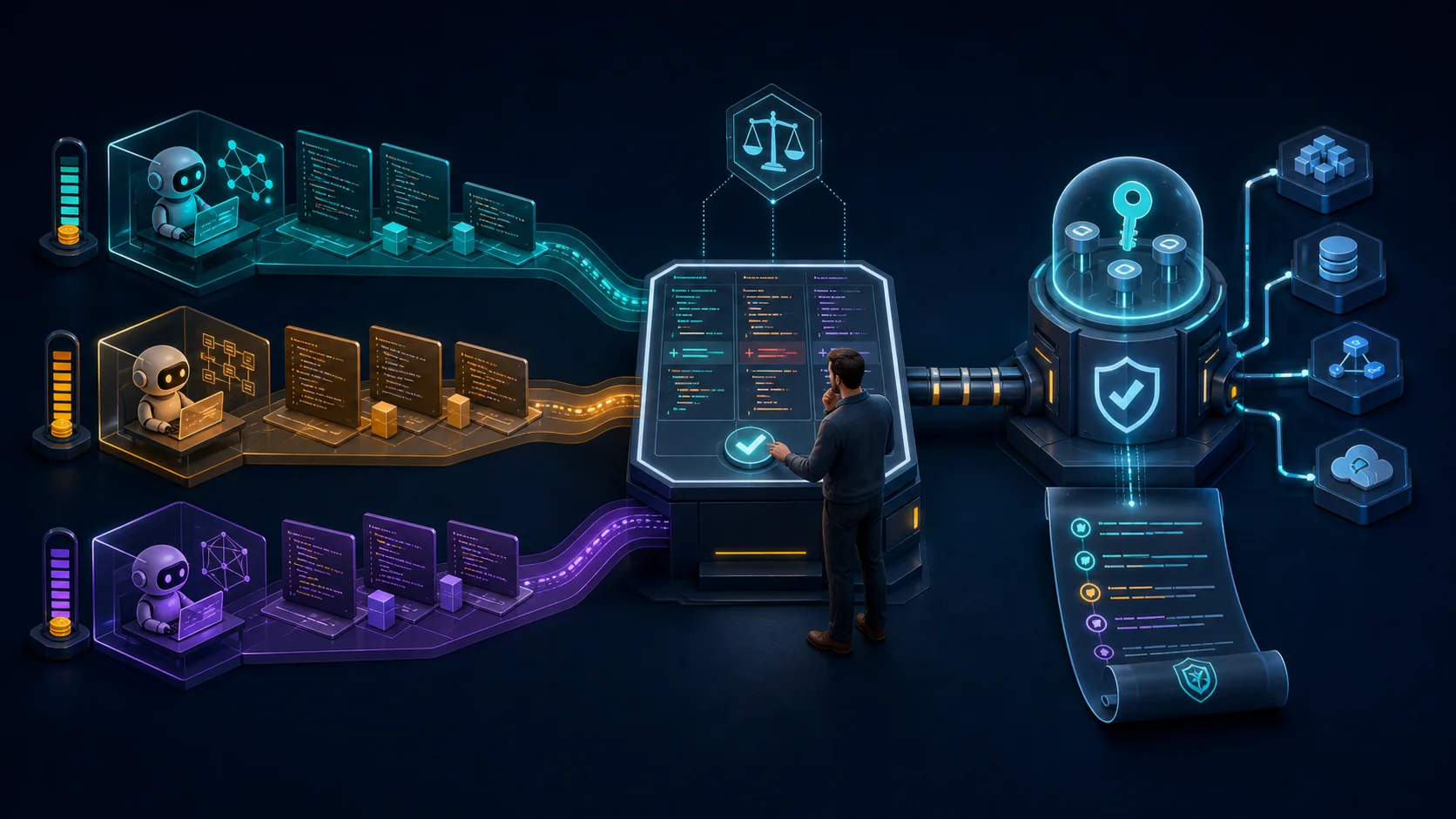
VS Code can organize more agent work in parallel and expose more credit usage, but teams still need isolation, scoped MCP access, and one accountable review path.
Continue your research in ToolVerse.
Open ToolVerse for evidence, pricing context, alternatives, and current review status. Every link below navigates to the external ToolVerse directory.
Explore AI coding tools Open on ToolVerse · externalGitHub Copilot parallel agents, cost visibility, and MCP security
Quick answer
GitHub’s July 8 changelog summarizes VS Code 1.123 through 1.127 as a shift toward more visible parallel agent work. Developers can keep sessions side by side, use multiple chats inside a session, organize workstreams, and inspect credit usage at session and subagent levels. These are coordination and observability features. They do not prove that simultaneous changes are compatible, that a task is complete, or that an MCP-connected action is authorized.
Adopt the workflow as a controlled queue. Give each workstream an explicit owner, file or subsystem boundary, acceptance test, permission set, and stop condition. Review the aggregate change before merge. Keep MCP servers behind scoped identity and approvals, and compare editor credit signals with the organization’s billing record before increasing concurrency.
What happened
On July 8, 2026, GitHub published a Copilot changelog covering VS Code releases 1.123 through 1.127, shipped during June and early July. GitHub highlighted parallel sessions, multiple chats within a session, session organization, whole-session cost visibility, additional-usage status, subagent credit visibility, and MCP OAuth credential support.
The underlying VS Code 1.123 notes are more precise about parallel viewing. They say multiple sessions can be open side by side, while only one is active at a time; Terminal, Files, and Changes views follow that active session. The same release documents preregistered OAuth client IDs for MCP servers and OS-backed storage for client secrets.
VS Code 1.127 documents multi-chat sessions in the agent host. Peer chats can run independently, progress and file changes are aggregated, and a fork can become another peer chat. It also says a user can hover over a subagent section to see the AI credits used by that subagent. These details support a richer operating view, but the documentation does not promise automatic task partitioning or safe merge resolution.
Confirmed details
The official sources establish three separate control surfaces.
First, session organization is a user-interface and workflow capability. Side-by-side sessions, background sends, groups, peer chats, and combined change counts can help a lead split implementation, testing, documentation, or review. The release notes do not say separate chats have independent filesystems. Unless the selected session type explicitly uses an isolated worktree or remote environment, teams should assume overlapping edits need coordination.
Second, cost visibility is not the same as a final invoice. GitHub’s changelog says VS Code can show total session credit usage, additional usage in the Copilot status dashboard, and usage for delegated subagent sections. GitHub’s current billing documentation defines one AI credit as $0.01 USD, says individual plans include allowances that vary by plan, and says organization or enterprise licenses contribute credits to a pooled billing entity. Actual included amounts, model rates, budgets, and billable overage rules remain plan-specific.
Third, MCP authentication is only one layer of security. VS Code 1.123 says a team can configure a preregistered OAuth client ID and keep a required client secret in encrypted OS-backed storage instead of plaintext configuration. GitHub’s MCP guidance says enterprise and organization use is controlled by a policy that is disabled by default, recommends OAuth rather than personal access tokens when available, and calls for minimum permissions, connection review, activity monitoring, and secret-leak prevention.
| Surface | Documented capability | Control still owned by the team |
|---|---|---|
| Parallel sessions | Side-by-side sessions and organized session lists | Work ownership, isolation, conflict detection, and acceptance |
| Multi-chat | Independent peer chats with aggregated progress and changes | Non-overlapping scopes and review of the combined result |
| Cost display | Session, additional-usage, and subagent credit signals | Billing reconciliation, budgets, unit economics, and pause limits |
| MCP OAuth | Registered client IDs and protected client-secret storage | Server trust, scopes, tool policy, approvals, logs, and revocation |
Why it matters
Concurrency can shorten elapsed time when tasks are genuinely separable. It can also multiply review debt: three plausible diffs may touch one shared contract, repeat the same investigation, or consume credits while blocked on the same dependency. The coding-agent rollout checklist provides the surrounding branch, CI, review, and ownership controls that the Agents window does not replace.
Cost needs the same unit of analysis. A session-level number is useful for finding an expensive workstream, while procurement needs cost per accepted outcome. The coding-agent pricing brief shows how to add retries, cloud execution, failed runs, and reviewer minutes to product usage. A cheaper-looking parallel run can be more expensive if its combined diff takes longer to reconcile.
MCP expands the action surface beyond repository text. An authenticated server can expose issues, files, databases, browsers, or internal operations. Use the MCP security checklist to evaluate identity, audience, scopes, downstream credentials, tool descriptions, approvals, logs, and revocation. OAuth and secret storage reduce specific credential risks; they do not make an untrusted server or overbroad tool safe.
Evaluation plan
Choose one change that divides cleanly into three workstreams, such as implementation, tests, and documentation. Freeze the starting commit, instructions, model, permissions, MCP configuration, time limit, and acceptance checks. Assign each chat a written boundary and prohibit edits outside it. For a shared repository, prefer isolated worktrees or sequential integration when the tooling supports them.
Record credits by workstream, elapsed time, tool calls, changed files, conflicts, failed checks, reviewer minutes, and whether the final result was accepted. Compare that with one session performing the same bounded task. Do not infer savings from elapsed time alone.
Run a second trial with an MCP server limited to read-only tools and synthetic data. Verify OAuth audience and scopes, deny an unauthorized tool, revoke the connection, and confirm the retained log identifies the initiating user and action. The coding-agent sandboxing guide helps separate file, command, network, secret, and process controls from the model’s behavior.
The GitHub Copilot ToolVerse profile can frame product comparison, but current documentation and the configured tenant remain authoritative for plan, policy, model, and billing details.
Limitations and remaining unknowns
This article did not operate the Agents window, run Copilot, connect an MCP server, or inspect a GitHub invoice. It reports features and billing concepts documented by GitHub and Microsoft on July 29, 2026. Product availability can vary by version, plan, tenant policy, agent provider, and rollout state.
The sources do not establish a universal concurrency limit, conflict-isolation guarantee, cost reduction, completion rate, or security outcome. An editor credit display may be useful before final billing data settles, but teams should test how it maps to their plan and reports. Encryption at rest for an OAuth client secret does not constrain the access token’s scopes or the MCP server’s downstream behavior.
Parallel work also changes human factors. More sessions can hide duplicated effort and increase context switching. Aggregated changes can make a large diff visible without making it understandable. Keep one person accountable for integration and require every workstream to preserve evidence for its claims.
Who is affected
Developer-platform teams own supported VS Code versions, session isolation, and MCP configuration. Engineering leads own task partitioning and final acceptance. Security and identity teams own server approval, OAuth registration, scopes, monitoring, and revocation. FinOps and billing administrators own budgets and reconciliation. Developers remain responsible for reviewing what their sessions changed and reporting uncertain or conflicting results.
What to do next
- Inventory the enabled Copilot, Agents window, agent-host, and MCP capabilities for the exact tenant and VS Code version.
- Define three non-overlapping workstreams, one integration owner, and acceptance checks before opening parallel chats.
- Start with read-only MCP tools, preregistered OAuth, minimum scopes, protected secrets, and an exercised revoke path.
- Compare one-session and parallel-session trials using accepted outcome, conflicts, review time, elapsed time, and credits.
- Reconcile VS Code credit views with GitHub usage reports and budgets; set a stop threshold before broader delegation.
- Expand only the task classes that improve verified throughput without increasing critical failures or review debt.
Sources and verification note
All five first-party sources listed above were publicly reachable on July 29, 2026. GitHub’s changelog establishes the July 8 event; VS Code release notes provide the detailed session, multi-chat, credit, and OAuth behavior; GitHub documentation provides the current billing and MCP security boundaries. Recheck release notes, tenant policy, model pricing, and billing reports before procurement or rollout.
FAQ
Do parallel Copilot sessions safely edit the same files?
The cited releases document side-by-side sessions, multi-chat workstreams, combined change views, and organization features. They do not establish conflict-free concurrent editing. Give workstreams separate ownership boundaries or worktrees, then review the combined diff and rerun verification.
Does VS Code show the complete cost of parallel agent work?
VS Code documents whole-session and subagent credit visibility, while GitHub documents AI-credit billing and plan allowances. Treat editor displays as operational signals and reconcile them with the billing entity's usage reports, budgets, and final charges.
Is an OAuth-authenticated MCP server automatically safe?
No. OAuth improves identity and token handling, but teams must still approve the server, limit tools and scopes, protect secrets, review connections, monitor actions, and test refusal and revocation paths.