Hybrid search guide for RAG systems that need better citations
Hybrid retrieval earns its complexity only when exact terms, semantic matches, reranking, and citation checks can be evaluated independently.
Compare the tools behind this article on ToolVerse.
Open ToolVerse for evidence, pricing context, alternatives, and current review status. Every link below navigates to the external ToolVerse directory.
Compare Pinecone and Qdrant and Elasticsearch Open on ToolVerse · externalHybrid search guide for RAG systems that need better citations
Quick answer
Hybrid search improves RAG citations by combining semantic vector retrieval with lexical or sparse matching, then using fusion, reranking, and citation checks to keep exact terms, entities, and source passages visible in the final answer. Dense retrieval helps with meaning. Lexical or sparse retrieval helps with names, acronyms, numbers, legal phrases, product IDs, and other exact-match signals. A RAG system that needs trustworthy citations often needs both.
The practical goal is not to add every retrieval technique at once. Start with a small evaluation set, measure which questions fail because the right passage was never retrieved, then add hybrid retrieval only where it solves a real recall problem.
Why hybrid search matters for RAG
RAG failures often look like generation failures, but many start earlier. The answer model cannot cite a source passage that never entered the context window. Dense embeddings are strong for semantic similarity, but they can underweight rare terms, exact phrases, table labels, ticket IDs, and short policy names. Keyword search is better at exact language, but it can miss paraphrases and conceptually similar passages.
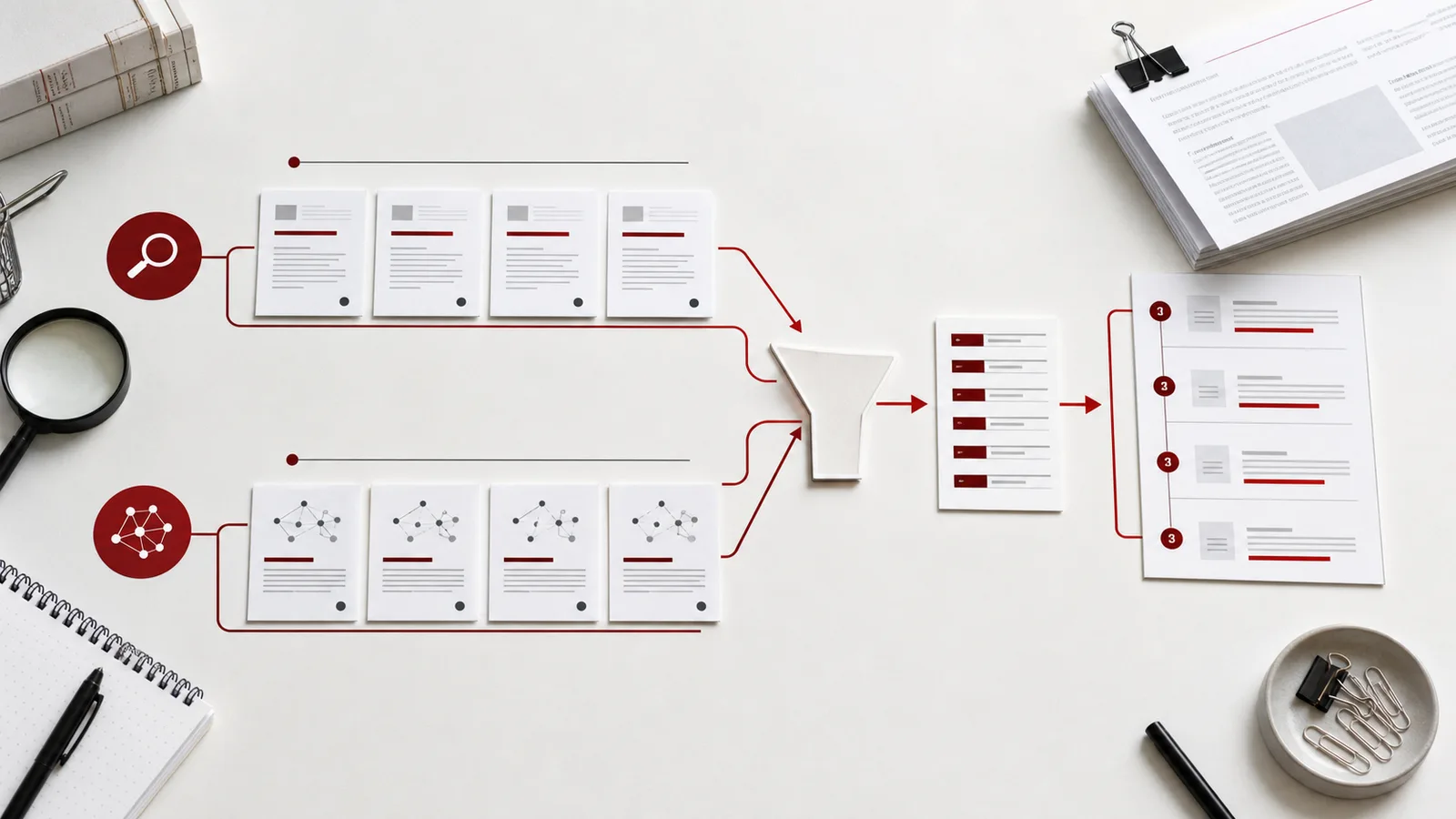
Hybrid search exists to combine those signals. Pinecone, Qdrant, and Elasticsearch all document patterns for combining dense semantic search with sparse or lexical retrieval. The details differ by platform, but the operating idea is stable: retrieve from multiple signals, combine candidates, rerank when needed, and test citation quality with realistic questions.
A practical retrieval stack
Use a four-stage stack for the first serious RAG pilot:
| Stage | Purpose | Good first implementation |
|---|---|---|
| Dense retrieval | Find passages with similar meaning. | Embeddings over normalized chunks with metadata filters. |
| Lexical or sparse retrieval | Preserve exact terms and named entities. | BM25, sparse vectors, or platform-native keyword retrieval. |
| Fusion | Merge candidate sets without losing either signal. | Reciprocal rank fusion or platform-native hybrid query. |
| Reranking and citation checks | Prioritize passages that answer the question and support citation. | Rerank top candidates, then verify quoted or cited passages are present. |
Do not skip metadata filters. Department, product, document type, date, locale, and permission scope often matter more than the retrieval algorithm. A perfect hybrid query over the wrong corpus is still wrong.
Decision framework
Choose the retrieval pattern by failure mode:
| Failure mode | Likely cause | Better retrieval move |
|---|---|---|
| Answers miss exact policy language. | Dense search finds similar topics but not the exact clause. | Add lexical or sparse retrieval with phrase-aware evaluation. |
| Answers cite broad documents but not the key passage. | Chunking is too large or citation scoring is weak. | Improve chunks and rerank passage candidates. |
| Answers retrieve stale documents. | Metadata is missing or filters are not used. | Add freshness metadata and source priority rules. |
| Answers fail on abbreviations or IDs. | Tokens are rare and poorly represented semantically. | Add exact-match search and alias dictionaries. |
| Answers include good context but weak final citations. | Generation prompt does not require source discipline. | Add citation validation after retrieval and before final answer. |
The key question is whether the correct source is absent, buried, or present but ignored. Hybrid search helps most when the correct source is absent or buried.
Tutorial: build a small hybrid pilot
- Select one corpus. Use a narrow collection such as support policies, product docs, contracts, or engineering runbooks.
- Create 30 to 50 evaluation questions. Include expected answer notes and expected source passages.
- Run dense retrieval alone. Record whether the correct passage appears in the top 5 and top 10.
- Run lexical or sparse retrieval alone. Record which exact-term questions improve.
- Fuse candidate lists. Start with a simple rank fusion method before tuning weights.
- Add reranking for the top 20 to 50 candidates. Measure whether the correct passage moves upward.
- Generate answers only after retrieval is stable. Do not tune prompts to hide retrieval failures.
- Add citation checks. Require the final answer to cite a retrieved passage that actually contains the claim.
This sequence keeps the test honest. If you generate answers too early, the model may make weak retrieval look acceptable with fluent language.
Citation quality checklist
| Check | Passing standard |
|---|---|
| Source recall | The expected source passage appears in the retrieved candidate set. |
| Passage precision | The cited passage directly supports the claim, not just the topic. |
| Entity match | Names, product IDs, policies, dates, and numbers match the source. |
| Freshness | The answer prefers current documents when old and new sources conflict. |
| Permission fit | The retriever does not expose passages the user should not access. |
| Regression stability | A known-good query keeps retrieving the same support passage after content updates. |
Teams often track answer quality but forget source recall. For citation-heavy workflows, source recall is the early warning signal.
Common failure modes
- Hybrid search is added without an evaluation set, so nobody knows whether it helped.
- Dense and lexical results are merged, but the final ranking still buries exact matches.
- Chunking splits headings from definitions, making citations vague.
- Metadata filters are treated as optional, leading to stale or unauthorized context.
- Reranking is tuned on friendly examples instead of real user questions.
- The generated answer cites a document title when the claim was not present in the retrieved passage.
The fix is measurement discipline. Track retrieval separately from generation. A RAG system can have a good answer model and still fail because retrieval is weak.
Source notes
The OpenAI web search guide frames retrieval as a tool-backed workflow. Pinecone, Qdrant, and Elasticsearch document different hybrid retrieval designs, including dense plus sparse signals, result fusion, and retriever composition. This article uses those docs as primary references, then translates them into an implementation sequence for teams trying to improve RAG citation quality.
Related reading path
- A RAG evaluation playbook before your document assistant goes live
- How to choose an AI search workflow without confusing every search product
- Reranking guide for RAG systems that need better answers
- Chunking strategy guide for RAG systems that need trustworthy citations
Read the evaluation playbook before changing infrastructure. Read the reranking guide if the right passages are retrieved but sorted poorly. Read the chunking guide if citations are too broad to trust.
Bottom line
Hybrid search is useful when RAG needs both semantic understanding and exact source discipline. Treat it as a retrieval-quality intervention, not a buzzword. Build a small test set, compare dense and lexical behavior, fuse carefully, rerank when needed, and verify that every important answer can point back to a real passage.
FAQ
When should a RAG system use hybrid search?
Use hybrid search when users ask about exact names, identifiers, policy terms, product codes, dates, or citations that dense semantic retrieval can miss even when the answer topic feels similar.
Does hybrid search replace reranking?
No. Hybrid search widens recall across lexical and semantic signals, while reranking helps sort the combined candidate set with a deeper relevance signal before the generator sees context.
What is the simplest hybrid search pilot?
Start with one corpus, one dense retriever, one lexical or sparse retriever, a fusion rule, a small reranker, and a 30 to 50 question evaluation set with expected source passages.