OpenHands review: repository tasks, sandbox boundaries, and cost
OpenHands can take on bounded repository work through a capable agent runtime, but adoption depends on task evidence, sandbox choices, credential scope, and review ownership.
Compare the tools behind this article on ToolVerse.
Open ToolVerse for evidence, pricing context, alternatives, and current review status. Every link below navigates to the external ToolVerse directory.
Compare OpenHands and Aider and SWE-agent Open on ToolVerse · externalBottom line
OpenHands is a credible candidate for teams that want a coding agent to do more than suggest the next line. Its official guidance describes repository-level work: reading and writing files, running tests and commands, using configured services, and working toward a requested change. Current documentation presents several ways to operate it, including local use, hosted Cloud, enterprise deployment, command-line and web experiences, and SDK-based integration.
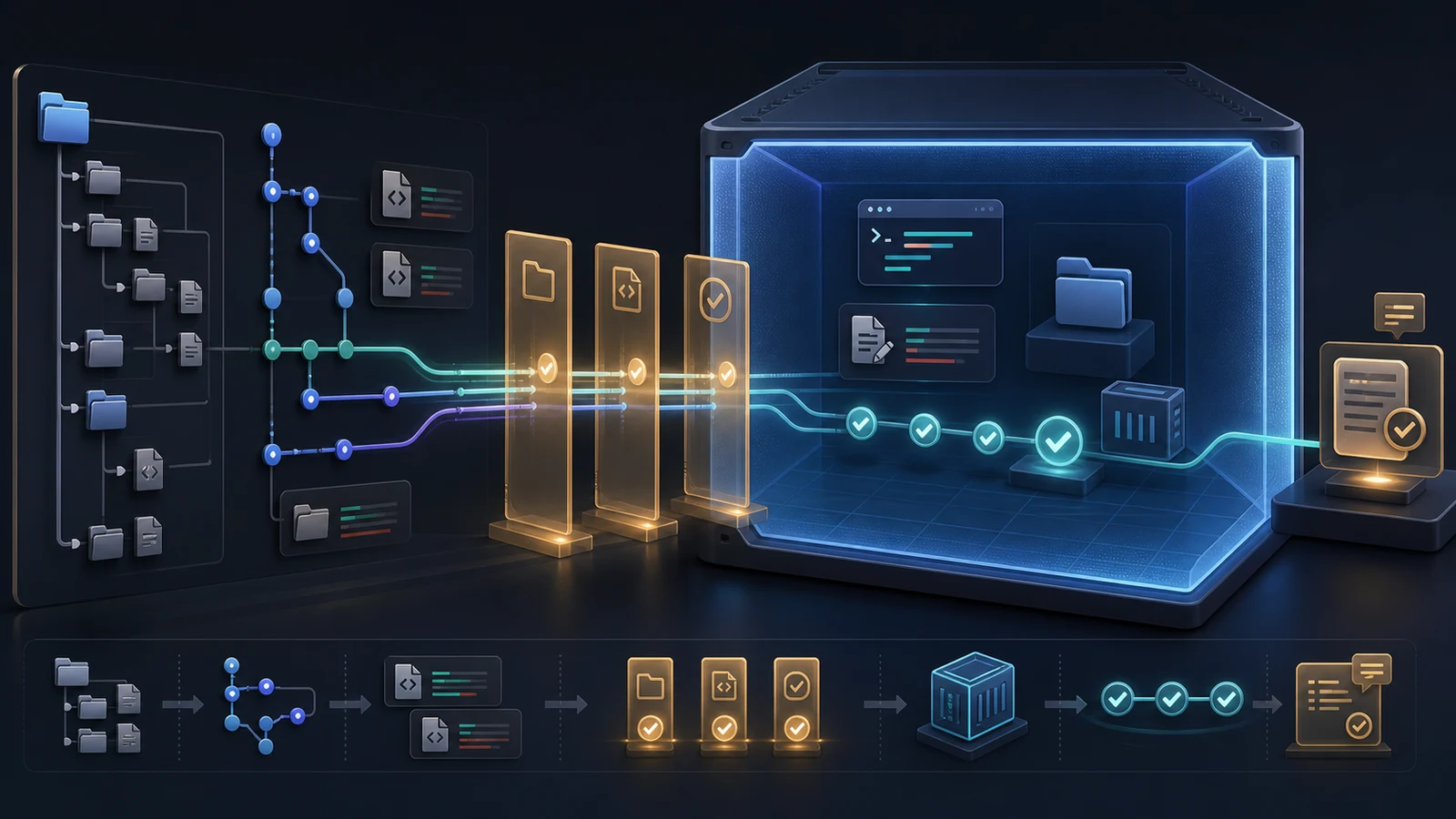
The important buying question is not whether OpenHands can edit code. It is whether it can complete the task classes a team actually delegates while staying inside a deliberately constructed authority boundary. A useful pilot freezes the starting commit, supplies an unambiguous issue, limits files and credentials, records tool actions, runs independent checks, and sends the patch to a human owner. A successful demonstration without those conditions says little about production fit.
The sandbox decision deserves equal weight with model choice. Current OpenHands documentation recommends a Docker sandbox, describes a faster process provider as unsafe because it has no container isolation, and supports remote sandboxes for managed setups. That boundary reduces some host exposure; it does not make arbitrary commands, mounted repositories, network calls, injected secrets, dependency scripts, or accepted patches inherently safe.
Shortlist OpenHands when open-source availability, model flexibility, repository tools, and deployment choice matter, and when an engineering owner can operate the surrounding controls. Skip broad autonomy when the organization cannot define acceptable tasks, least-privilege access, independent verification, and rollback. This is a source-verified editorial review based on public evidence, not a performance benchmark or security assessment.
Who it is for
OpenHands is best suited to an engineering group with a backlog of bounded, reproducible repository work. Official guidance identifies tasks such as fixing a bug with reproduction steps, implementing a specified feature, writing tests, performing a scoped refactor, improving documentation, and handling routine maintenance. These jobs expose whether the agent can connect issue context to source files, commands, test feedback, and a reviewable patch.
Three buyer profiles stand out:
- A developer-platform team evaluating a common agent runtime across repositories while preserving normal CI, code ownership, and branch protections.
- A product team that wants issue-to-pull-request assistance for low-risk maintenance and can provide strong tests and explicit completion criteria.
- An applied-AI team that values an open, model-agnostic agent and is prepared to compare model, sandbox, and instruction combinations on private tasks.
Repository preparation materially affects the result. OpenHands documentation supports repository instructions, a .openhands/setup.sh initialization script, and stop hooks that can block completion until project checks pass. Those mechanisms can reduce repeated setup work and encode local expectations. They also become part of the reviewed execution surface: setup scripts run code, instructions can become stale, and a stop hook is only as meaningful as the checks behind it.
The best AI coding agent tools guide helps separate the agent from the evaluation, CI, review, and policy layers around it. OpenHands can occupy the repository-agent layer; it should not be credited with controls supplied by the team’s protected branches, security scanners, test harness, or reviewers.
Who should skip it
Skip OpenHands for work whose success cannot be stated before the run. An agent cannot infer an unwritten product decision, reconcile absent business context, or guarantee that a plausible implementation is the maintainable one. The official suitability guide warns about long-running sessions, interactive debugging, visual verification, external-service access, large-codebase context, and the need for human judgment on critical decisions.
Teams should also pause when the only security plan is “use Docker.” The sandbox still receives some combination of repository files, commands, package managers, network access, model context, and credentials. A writable mount can damage the permitted workspace. A broad token can affect the Git host. A dependency install can execute code. A generated test can make a bad patch look accepted. Container isolation is one control in a chain, not a final verdict.
Other poor-fit conditions include:
- The repository has no reliable build, test, lint, or policy checks.
- Tasks routinely require production credentials, unrestricted network access, infrastructure mutation, or irreversible data changes.
- Reviewers cannot inspect the complete diff and evidence before merge.
- No owner can troubleshoot sandbox images, mounts, model configuration, tokens, upgrades, and failed sessions.
- Procurement assumes “open source” eliminates model, compute, support, and operational cost.
- A public coding benchmark is being treated as proof for a private monorepo, language, or security posture.
The coding agent sandboxing guide provides a fuller boundary checklist. If file, command, process, network, secret, and approval policies are unresolved, tool selection is premature.
Capabilities and limitations
Official sources govern capability claims here. OpenHands documentation says the agent can read and modify repository files, run shell commands and tests, browse reference material, and access services for which the operator supplies configuration. The Cloud GitHub integration can be limited to selected repositories, but its documented short-lived token permissions include read and write access across contents, issues, pull requests, actions, workflows, commit statuses, and webhooks. That is functional authority, not a passive read connection.
The current sandbox overview distinguishes Docker, process, and remote providers. Docker places the agent server in a container and is the recommended option. Process mode runs directly on the machine without container isolation. Remote mode moves execution to another environment and is used by managed deployments. A decision record should name the provider, mounts, user identity, resources, egress rules, accessible services, and destruction or reset behavior rather than simply say “sandboxed.”
Action confirmation is another relevant control. The SDK security guide documents policies that always confirm, never confirm, or confirm actions classified as risky through a security analyzer. Confirmation can reduce unintended execution, but it is not an oracle. Review fatigue can turn repeated prompts into automatic approval, and an analyzer can misclassify context-dependent commands. High-impact actions should still be blocked or isolated by deterministic infrastructure policy where possible.
A representative repository evaluation should include:
- A localized defect with a failing regression test.
- A change spanning several modules without permission to rewrite unrelated code.
- A dependency or setup failure that requires diagnosis rather than repeated installation.
- A hostile instruction embedded in a file, issue, test fixture, or tool response.
- A task that must stop because required business context or credentials are absent.
- Reviewer feedback requiring a narrow revision without losing earlier constraints.
Measure accepted completion, not activity. Record whether the original symptom is fixed, independent tests pass, the diff stays in scope, new vulnerabilities appear, secrets or prohibited paths are touched, and a maintainer can understand the result. Also record abstention: refusing an under-specified or prohibited task can be a better outcome than producing code.
Model choice is a major confounder. OpenHands can be model-flexible, but changing the model, context limits, tool behavior, retry policy, or budget can change task results and cost. A comparison must hold those variables constant or identify them explicitly. The product documentation establishes possible behavior; only the buyer’s controlled task set establishes local fit.
Community feedback: consensus and disagreement
Community evidence is self-selected, version-specific, and not reproduced by ToolVerse. It cannot establish current defect rates, typical performance, or general customer satisfaction. The four items reviewed here support two test themes because each theme appears in more than one independent report.
The first theme is sandbox and installation ownership. GitHub issue 13109 reports that a particular Docker Compose combination could not start tasks because a workspace directory failed to initialize. A separate 2025 Reddit author describes difficult local-model configuration and raises concern about exposing a container engine socket so the application can create per-project runtimes. These reports concern different versions and symptoms. Together they justify testing image compatibility, path and mount behavior, container-engine exposure, startup diagnostics, and recovery. They do not prove that current installations generally fail or that every supported deployment uses the same host boundary.
The second theme is repository context and operating process. GitHub RFC 13275 describes an automation path in which SDK-created Cloud conversations did not inherit dashboard visibility, credentials, repository context, or setup scripts needed by the proposed workflow. In a separate Reddit discussion, an author seeking repository automation found both Aider and OpenHands difficult to map to the desired autonomy, while a respondent emphasized adapting team processes and written procedures. Together, these items support testing how task context, credentials, instructions, setup, and handoff reach each execution path. They do not establish a universal integration gap.
There is disagreement about how much autonomy is desirable. Some users seek issue-to-patch execution with little intervention. Others prefer a terminal tool that stays close to a developer and asks for steering. That is not resolved by declaring one interface more advanced. It is resolved by matching task risk, review capacity, and recovery cost to the level of delegated authority.
Two independent security studies add a separate warning without providing a product ranking for ordinary use. The paper by Yibo Peng and coauthors tests functionally correct patches under an attack design and includes OpenHands among several agent-model combinations. SecureVibeBench, authored by Junkai Chen and colleagues, compares OpenHands, Aider, and SWE-agent on reconstructed vulnerability-introducing scenarios. Their shared decision lesson is narrow: functional acceptance and secure acceptance must be measured separately. Their reported results belong to their selected repositories, models, prompts, scaffolds, and threat models; they are not generalized here to current product reliability.
Cost and operational ownership
The pricing page checked July 29, 2026 lists the local open-source option as free, the hosted Individual tier as free, and Enterprise as custom pricing. It says Individual users can bring their own model key or use OpenHands-provided models at cost, with a published limit of ten daily conversations. Enterprise is presented as SaaS or self-hosted, with private-VPC and bring-your-own-key options plus organizational controls. These terms are time-sensitive and should be reconfirmed during procurement.
“Free” does not mean costless repository work. Local operation can require model API usage, Docker resources, image storage, dependency downloads, CI minutes, logs, security review, and engineering time. Hosted use can move runtime operation to the provider while retaining model charges, usage limits, data-boundary review, integration administration, and reviewer time. Enterprise adds commercial terms that cannot be inferred from a public custom-price label.
Track cost per accepted patch or completed maintenance outcome. Include failed attempts, retries, reviewer minutes, CI, model tokens, environment startup, incident investigation, and cleanup. A cheaper model that creates more rework may cost more than a stronger model. An autonomous run that saves author time but adds security and review burden has shifted cost rather than removed it.
Self-hosting needs a named owner for versions, images, ingress, authentication, sandbox capacity, token handling, logs, backups where state matters, and incident response. Hosted operation still needs an owner for repository allowlists, user lifecycle, tokens, data policy, model configuration, spending, and audit review. Neither deployment transfers responsibility for accepting the patch.
Alternatives
OpenHands on ToolVerse is the reference profile when the desired shape is an open coding agent with repository tools, sandbox choices, model flexibility, and hosted or self-managed paths.
Aider on ToolVerse is a useful alternative when developers prefer a terminal-centered, human-steered editing loop and want tighter conversational control over commits and diffs. Compare the same tasks rather than assuming a more interactive workflow is automatically safer or slower.
SWE-agent on ToolVerse belongs in the evaluation when research-oriented issue resolution, a configurable agent-computer interface, and reproducible benchmark workflows matter. Confirm the current deployment and maintenance model rather than transferring study results into a production recommendation.
An IDE-integrated assistant may be preferable when the developer should remain present for every edit. A managed background agent may be preferable when identity, ephemeral environments, pull-request handoff, and administration are more valuable than self-hosting. A narrow script or conventional automation remains better for deterministic repository chores with stable inputs and outputs.
Recommendation
Pilot OpenHands only against a written operating contract. Choose two or three low-risk task classes, freeze representative starting commits, and specify allowed repositories, paths, commands, network destinations, credentials, budget, and completion checks. Start with a Docker or remote sandbox whose actual isolation and reset behavior the platform team has reviewed. Keep protected branches and require a human-owned pull request.
Use tests the agent did not author as the primary acceptance layer. Add static analysis, dependency review, secret scanning, and targeted security cases appropriate to the repository. Seed one task with a hostile or irrelevant instruction and one with missing business context. A trustworthy workflow should remain in scope and stop when it lacks authority or evidence.
Compare OpenHands with at least one credible alternative under the same conditions. Record accepted completion by task type, unsafe or unrelated edits, review minutes, recovery time, model and infrastructure cost, and the number of runs requiring intervention. Preserve failed trajectories and reviewer corrections because they reveal the next control or task boundary.
Expand only task classes that repeatedly pass. Do not generalize success on tests or documentation to authentication, payments, infrastructure, migrations, or production incidents. Re-run the evaluation after material changes to OpenHands, the model, sandbox image, repository instructions, permissions, or CI. The goal is not maximum autonomy; it is a maintainable amount of delegated repository work with evidence and a reversible failure path.
Method and limitations
This review was verified on July 29, 2026. OpenHands documentation, the official repository and MIT license, and the hosted pricing page govern statements about suitable tasks, sandbox providers, action confirmation, repository access, customization, licensing, plans, and published limits. Pricing, product packaging, documentation paths, token scopes, and defaults can change.
Community evidence comprises two declared GitHub items and two Reddit discussions. Each item is self-selected and tied to a particular date, version, configuration, or proposed workflow. The sandbox-ownership and repository-context themes each use two independent reports, but neither theme is a prevalence estimate or a claim about current installations.
The independent layer uses two authored, non-vendor security studies that include OpenHands and adjacent coding-agent systems. They demonstrate why security needs a separate evaluation dimension. This review does not extrapolate their benchmark figures beyond the studies’ models, repositories, prompts, tools, attack assumptions, and dates.
ToolVerse did not perform hands-on testing. It did not install, run, benchmark, load-test, or penetration-test OpenHands. No rating, performance guarantee, security certification, or production case claim is offered. Readers should verify current contractual terms and run a controlled pilot in their own repository and threat model before granting broad access.
FAQ
Can OpenHands safely work on a private repository?
It can be configured for private repositories, but safety depends on the selected sandbox, exact repository allowlist, token permissions, secret exposure, network policy, confirmation mode, branch protection, and independent review. A private repository is not itself a security boundary.
Is the open-source OpenHands product free for commercial use?
The reviewed repository carries an MIT license, and the pricing page describes the local open-source option as free. Teams must still pay for model usage, compute, storage, CI, security controls, and operator time, and should review current licenses and commercial terms for their intended deployment.
How should a team compare OpenHands with Aider or SWE-agent?
Run each credible candidate from the same frozen commits with identical tasks, model budgets, permissions, network rules, and acceptance checks. Compare accepted completion, unsafe or out-of-scope changes, reviewer minutes, recovery, and total cost instead of transferring a public benchmark result to a different repository.