RAGFlow review: document fit, limitations, cost, and alternatives
RAGFlow offers an integrated document-centered RAG platform, but its value depends on representative parsing quality and a team's willingness to operate a substantial service stack.
Compare the tools behind this article on ToolVerse.
Open ToolVerse for evidence, pricing context, alternatives, and current review status. Every link below navigates to the external ToolVerse directory.
Compare RAGFlow and LlamaIndex and Haystack Open on ToolVerse · externalBottom line
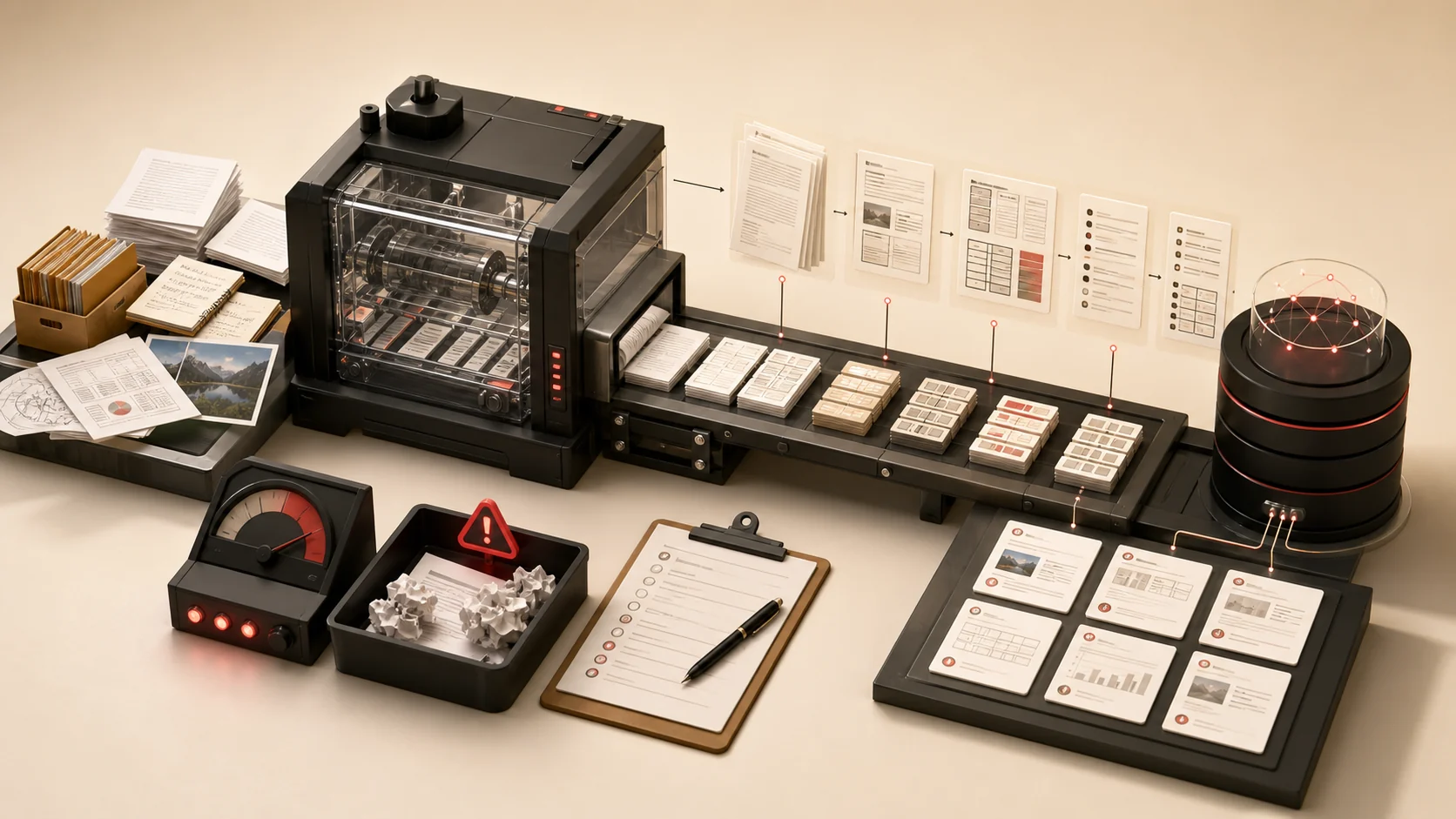
RAGFlow is attractive because it assembles many parts of a document-grounded AI system: ingestion, parsing, chunk inspection, knowledge bases, retrieval, citations, model configuration, APIs, and agent or chat workflows. A team can evaluate a coherent platform instead of wiring a parser, retrieval framework, database, UI, and service layer separately.
The same integration creates the principal tradeoff. RAGFlow is not a small dependency. Its official repository documents a multi-service self-hosting path and material resource prerequisites. Operators inherit storage, search, databases, models, workers, upgrades, monitoring, backup, security, and recovery. A polished ingestion screen does not prove that the resulting answers are permission-correct or supported on the buyer’s corpus.
RAGFlow belongs on a shortlist when complex documents and an integrated operating surface are central requirements. Teams that want a code-first library, a narrow retrieval component, or minimal infrastructure should compare LlamaIndex, Haystack, and simpler services before committing.
This review is source-verified. ToolVerse did not install the platform or claim an independent quality benchmark.
Who it is for — and who should skip it
RAGFlow is best suited to teams that:
- Need to ingest PDFs, office documents, tables, or mixed layouts and want parsing controls visible in one system.
- Prefer a deployable application with UI and APIs over building every RAG service from libraries.
- Have engineers able to operate containers, persistence, search infrastructure, model connections, and upgrades.
- Will evaluate retrieval and answer quality with a customer-owned dataset.
- Need self-hosting as one option but understand that connected model and storage services can still cross data boundaries.
Skip or delay RAGFlow if the use case is a small, stable collection that a conventional search index and a thin application can serve. It may also be a poor fit when the organization cannot own a multi-component service or requires a managed support boundary that has not been contracted.
Research teams seeking maximum freedom to replace each component may prefer frameworks. Non-technical teams may prefer a managed product with clear operational and support obligations. A self-hostable project is not automatically easier to govern.
Capability and operating boundary
Official materials describe RAGFlow as an open-source RAG engine with document understanding and agent capabilities. The repository documents self-hosting, model providers, retrieval, reranking, APIs, and deployment prerequisites. Releases show active product change, which is both a strength and an upgrade-management obligation.
| Decision area | RAGFlow shape | Buyer question |
|---|---|---|
| Document ingestion | Integrated parsing and chunk workflow | Does it preserve the tables, headings, footnotes, and reading order that matter? |
| Retrieval | Configurable search and reranking within the platform | Can required passages be retrieved consistently on a versioned dataset? |
| User workflow | UI, knowledge bases, chat and agent surfaces | Do roles and permissions match the organization’s users and sources? |
| Integration | APIs and model or storage configuration | Are contracts stable enough for the application’s lifecycle? |
| Deployment | Multi-service self-hosted stack | Who owns capacity, upgrades, backup, security, and incident response? |
| Evaluation | Platform signals plus external evaluation options | Can the customer export traces and results into an independent gate? |
The integrated surface can reduce early assembly work. It can also make it harder to replace one component without understanding platform assumptions. Test export and fallback before production adoption.
Document parsing and retrieval fit
RAG quality begins before embeddings. A parser must preserve the structure that makes a passage meaningful. Multi-column reading order, table headers, captions, footnotes, repeated page furniture, scanned text, and nested sections can all corrupt retrieval.
RAGFlow’s document-centered positioning is a reason to test it, not a reason to assume it wins. Build a corpus of representative files and label:
- Required text and table fields.
- Expected section and parent relationships.
- Reading order.
- Material footnotes and exceptions.
- Page and bounding references needed for review.
- Content that should be excluded.
Compare RAGFlow with the organization’s current parser and at least one alternative. Measure field or claim accuracy, required-passage retrieval, citation usability, review minutes, ingestion failures, and exception cost. A visually attractive chunk preview may still hide missing table context.
Use the document AI platform selection guide for file-level scoring and the RAG evaluation dataset guide for answer behavior.
Self-hosting and operational complexity
The official repository’s prerequisites and Docker guidance make clear that self-hosting requires real capacity and several services. Exact requirements change, so infrastructure planning must use the current release and chosen configuration.
Operators should answer:
- Which components persist documents, parsed content, indexes, credentials, conversations, and traces?
- How are backups created and restored across dependent stores?
- What is the safe upgrade and rollback sequence?
- How are ingestion jobs retried without duplicating or corrupting state?
- What alerts distinguish a stuck parser, failed embedding, degraded search, and model-provider outage?
- Which network destinations are allowed?
- How are tenant and user permissions propagated into retrieval?
Public issues about stalled parsing, model downloads, database configuration, and shared GPU contention illustrate useful failure drills. They do not prove every deployment has those defects. Reproduce the class of failure in the target architecture and verify operators can see and recover it.
Permissions, governance, and traceability
RAGFlow can sit inside a sensitive document path. A buyer needs more than login controls. Test whether source permissions remain attached through ingestion, chunking, retrieval, model context, citations, cache, logs, and exports.
Create two users with different access to the same query. Denied chunks must not enter candidate retrieval or model context. Filtering after generation is too late. Shared service credentials should not silently widen source access.
Trace one answer from user and corpus revision through retrieved chunk identifiers to cited evidence. Preserve enough information for an investigator without copying all sensitive content into a broad telemetry store.
Review model-provider settings, telemetry, support access, update sources, and container supply chain. Self-hosting the UI and indexes does not guarantee that prompts, embeddings, or generated answers remain local.
Community feedback: consensus and disagreement
Public discussions consistently highlight interest in RAGFlow’s integrated document workflow and UI. Practitioners comparing open-source RAG stacks often distinguish it from library-first systems such as LlamaIndex and Haystack.
The same sources raise recurring operational questions: resource requirements, ingestion that appears stuck, model or database configuration, timeouts, and the complexity of running a full stack. GitHub issues are especially useful because they include version and environment details, but open issues are not a reliability rate and may include configuration errors or resolved behavior.
There is disagreement over whether an integrated platform is easier. It can be easier for application assembly and harder for operations. A team with strong container and search operations may prefer the visibility; a small team may find a managed service or focused library easier overall.
Reddit and issue reports are self-selected. This review uses themes to design pilot tests and does not infer satisfaction, market share, or current defect frequency.
Cost and resource planning
The repository is open source, but total cost includes:
- Compute and memory for application, parser, workers, search, and databases.
- Storage for raw documents, parsed artifacts, indexes, logs, and backups.
- GPU or model-provider charges for OCR, embeddings, reranking, generation, and agents.
- Network transfer and backup.
- Engineering for deployment, upgrades, monitoring, security, and recovery.
- Domain review and exception handling.
Calculate cost per verified answer and per successfully ingested document. Include failures: a difficult PDF that requires manual remediation can dominate the economics even when routine files are cheap.
Run normal, peak, and reindex scenarios. Measure ingestion queue time, query latency, resource saturation, retry behavior, and recovery. Pricing comparisons that ignore operator and reviewer time are incomplete.
Alternatives
LlamaIndex is a strong alternative when a team wants data and retrieval primitives in application code with broad configurability. Haystack offers modular pipelines and explicit component composition suited to teams that want a framework rather than a full UI-led platform. Dify, AnythingLLM, and other integrated applications occupy adjacent territory with different workflow and operating choices.
A managed RAG service may be preferable when support, availability, and faster setup outweigh deep control, subject to data and exit requirements. A conventional search system with a thin answer layer can be the most maintainable option for narrow, stable collections.
The existing managed vs open-source RAG guide helps decide whether platform operation is strategically justified.
A representative RAGFlow pilot
Build the pilot around a frozen corpus that resembles the production mess, not a handful of clean demonstration PDFs. Include native PDFs, scans, long tables, repeated headers, diagrams, versioned policies, documents with access restrictions, and at least one file that should fail ingestion. Preserve a corpus manifest with file hash, source owner, access group, effective date, expected parser behavior, and the exact question cases attached to each document.
Create separate evaluation layers. The ingestion layer checks whether pages, tables, headings, and metadata survive parsing. The retrieval layer records whether the supporting chunks appear in a bounded candidate set. The answer layer checks claim support, citation precision, completeness, and correct abstention. The operations layer measures queueing, retries, recovery, backup, restore, deletion, and reindexing. A polished answer cannot compensate for permission leakage or an irreproducible ingestion path.
Run the same dataset against one simpler baseline, such as a framework pipeline with a conventional parser and search service. Freeze embedding, reranking, and generation models where possible so the comparison does not accidentally reward different model choices. Record all configuration, prompts, corpus revisions, and random seeds that affect the result.
The pilot scorecard should include:
- Successful ingestion by document class and failure reason.
- Retrieval recall at a fixed candidate count.
- Supported-claim and citation-precision rates.
- Correct abstention for unanswerable or denied questions.
- P50 and P95 ingestion and query latency.
- Operator minutes per failed document and per upgrade.
- Cost per successfully processed document and verified answer.
- Restore time and evidence that deleted documents leave indexes, caches, and exports.
Investigate outliers rather than hiding them in an average. One permission leak is a release blocker. A small number of table-heavy documents may justify a specialized parser even when the aggregate score looks acceptable. A slower system may still win if its evidence and recovery paths are substantially clearer.
At the end, export the corpus manifest, evaluation results, configuration, relevant logs, and an ownership runbook. Then perform a clean restore into a separate environment and repeat a small acceptance set. That exercise reveals whether the team has evaluated a reproducible system or only one working installation.
Recommendation
Shortlist RAGFlow when document parsing and an integrated platform are material requirements. Run a six-week pilot on a frozen representative corpus. Include difficult tables, scanned pages, conflicting versions, unanswerable questions, permission-denied cases, and ingestion failures.
Compare it against one framework-based baseline. Require:
- Better or meaningfully easier document and retrieval quality.
- No permission leakage.
- Reproducible citations and exported evidence.
- Bounded ingestion and query recovery.
- A successful backup and restore.
- Acceptable full cost and operator workload.
- A documented fallback and exit package.
Reject a rollout based only on GitHub popularity, a quick-start success, or a vendor-quality demo corpus.
Method and limitations
ToolVerse reviewed RAGFlow’s official repository, documentation, releases, and Docker guide on July 29, 2026. Public issues and Reddit discussion informed operational test cases. Independent framework comparisons informed alternative categories.
ToolVerse did not install RAGFlow, parse a document, run a retrieval benchmark, measure resources, or verify support. Public issues may describe old versions, unusual infrastructure, or configuration errors. Independent articles can simplify differences or contain commercial incentives.
Recheck the current release, license, security guidance, prerequisites, integrations, and model-provider paths before adoption. Use a customer-owned RAG evaluation dataset and preserve exact versions in the decision record.
FAQ
Is RAGFlow a framework or a complete RAG application?
It is closer to an integrated platform than a narrow library: official materials combine document ingestion and parsing, retrieval, knowledge bases, chat or agent workflows, APIs, and an operational service stack.
Can RAGFlow run without a GPU?
Deployment and model choices change over time. Check the current prerequisites and test the exact parser, embedding, reranking, and model configuration under representative load before planning capacity.
Is RAGFlow better than LlamaIndex or Haystack?
They expose different operating boundaries. RAGFlow offers a more integrated platform, while LlamaIndex and Haystack are typically chosen as programmable frameworks. The right choice depends on control, UI, parsing, deployment, and ownership needs.
What should a RAGFlow pilot measure first?
Start with parsing fidelity on difficult documents, required-evidence retrieval, citation support, permission-denied cases, ingestion recovery, latency, resource use, and the ability to export data and configuration.