Dify review: enterprise RAG workflows, self-hosting, and cost
Dify packages visual workflows, knowledge pipelines, publishing, and monitoring into one platform, but enterprise fit depends on retrieval evidence and ownership.
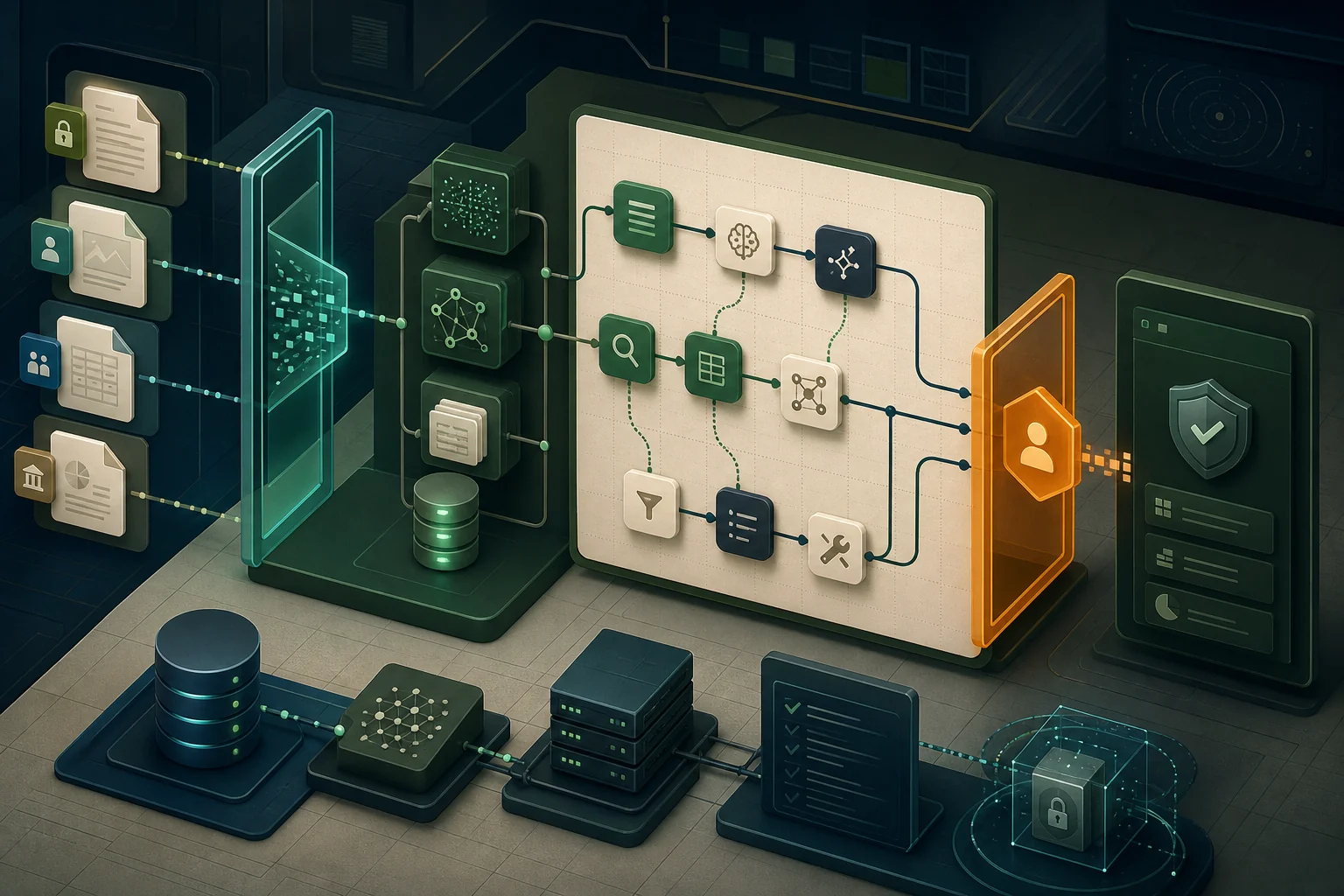
Compare the tools behind this article on ToolVerse.
Open ToolVerse for evidence, pricing context, alternatives, and current review status. Every link below navigates to the external ToolVerse directory.
Compare Dify and Flowise and RAGFlow Open on ToolVerse · externalBottom line
Dify deserves an enterprise RAG shortlist when the buyer wants a visual application platform rather than a retrieval library or a bare workflow canvas. Official documentation positions it as an open-source platform for agents, agentic workflows, chatbots, web apps, and APIs. The repository adds a built-in RAG pipeline, model management, tools, monitoring, and cloud, VPC, or self-hosted deployment. That combination can reduce the number of separate products needed to turn a document assistant into an operated application.
The same breadth creates the central buying risk. A visual knowledge pipeline can make ingestion, chunking, retrieval, and generation easier to configure, but it does not prove that answers are correct, permission-safe, current, or recoverable. An enterprise still has to establish source ownership, identity propagation, evaluation sets, failure handling, retention, model-provider boundaries, and operational responsibility. Dify packages the control surface; it does not supply the buyer’s acceptance evidence.
Hosted and self-hosted Dify are also different operating decisions, not merely two installation options. Dify Cloud transfers platform operation to the vendor and applies published workspace, member, app, document, storage, request, trigger, and log limits. Community Edition puts infrastructure and upgrade responsibility on the customer. Enterprise adds commercial authorization and separately listed controls. The right edition follows from the required boundary and owner, not from a general preference for cloud or open source.
This is a source-verified editorial review. ToolVerse did not install, deploy, use, benchmark, security-test, or load-test Dify. The recommendation is therefore a shortlist and pilot framework, not a performance claim.
Who it is for
Dify fits teams that want product and platform concerns close together. A knowledge lead can define documents and retrieval behavior, a workflow builder can connect model, tool, conditional, and transformation steps, and an application team can publish through an interface or API. That shared surface is useful when a pilot must become an internal assistant without rebuilding every surrounding capability.
Three buyer profiles are especially plausible:
- An enterprise knowledge team building a permission-aware policy, support, research, or operations assistant.
- An AI platform team standardizing model access and reusable workflows across several applications.
- A product team that values visual iteration, built-in knowledge management, and publishing more than framework-level control.
The strongest fit is a bounded workflow with named sources, an observable answer contract, and a clear human review point. Examples include drafting a support response from approved manuals, extracting structured fields from controlled documents, or routing a knowledge answer for specialist approval. These are workflow shapes, not claims that Dify succeeds on a particular corpus.
The managed versus open-source RAG decision framework is useful before choosing an edition. It separates product convenience from infrastructure ownership and prevents “self-hosted” from becoming an unexamined proxy for control.
Who should skip it
Skip Dify when the actual requirement is a small retrieval component inside an existing application and the team prefers code-reviewed configuration, custom state machines, or a narrow runtime. A full application platform can become unnecessary operational weight when one service, one index, and one API are sufficient.
Teams should also pause when authorization depends on complex document-level or row-level policies that have not been demonstrated end to end. Upload controls and workspace membership are not substitutes for retrieval-time permission enforcement. If the source system changes access, a production design needs a tested synchronization and revocation path.
Dify Community Edition is not an automatic fit for a business that intends to expose separate workspaces as an unapproved multi-tenant service or remove protected frontend branding. The official license is based on Apache 2.0 but adds conditions for those situations. This is a legal-review trigger, not a minor documentation footnote.
Finally, skip self-hosting if no team owns database and vector-store persistence, secrets, network policy, patching, backup, restore, capacity, and incident response. The current Docker quick start describes seven core services, eight dependent components, and a one-time permissions task. A successful start command is only the beginning of operating that system.
Capabilities and limitations
Official sources support four capability groups. First, the visual workflow layer connects model, retrieval, agent, tool, and logic steps. Second, the knowledge layer covers document ingestion through retrieval. Third, applications can be published as web experiences or integrated through APIs. Fourth, logs and monitoring provide an operating record that can inform later prompt, dataset, and model changes.
For enterprise RAG, the valuable unit is the whole evidence path:
- A source enters through an approved connector or upload process.
- Parsing preserves the structures needed to answer the target questions.
- Chunking and metadata retain source identity, version, owner, and access group.
- Retrieval returns the right evidence under the caller’s permissions.
- The workflow handles insufficient evidence, conflicts, and tool failures.
- The response carries citations that a reviewer can inspect.
- Logs connect the answer to the workflow, model, dataset, and configuration version.
Dify can represent much of this path, but documentation of a feature is not proof of local behavior. PDF tables, scans, duplicate policies, multilingual terminology, stale documents, and permission changes all require representative tests. Retrieval quality should be measured before generation so a fluent answer cannot hide missing evidence.
The hosted boundary introduces quotas and vendor operations; the self-hosted boundary introduces a multi-service stack. The Docker documentation lists minimum hardware of two CPU cores and four GiB of RAM, plus platform-specific software requirements. Those figures establish quick-start eligibility, not production capacity. Corpus size, concurrent indexing, vector-store choice, workflow fan-out, model latency, and log retention can change the required footprint.
Security claims also need careful scope. The repository security policy explains private vulnerability reporting and encourages current deployments; it does not certify a reader’s configuration. The pricing page lists SSO and advanced security and controls under Enterprise. A buyer should confirm exact edition availability, identity-provider behavior, audit coverage, egress controls, encryption, support, and remediation terms in current contractual material.
Community feedback: consensus and disagreement
Public reports cluster around two recurring themes, each supported by two items in this source set. They are useful for designing pilot cases, not for estimating prevalence.
The first theme is self-hosting ownership. GitHub issue 13791 describes data loss after an upgrade of an older Docker deployment. A Reddit thread about connecting a self-hosted instance to documents in Google Cloud shows a different part of the same burden: installation does not settle source synchronization, parsing, credentials, or ongoing ingestion. Together, the reports support testing backup, restore, migration, connector behavior, and reindexing before production. They do not establish that current releases generally lose data or that every cloud-source integration fails.
The second theme is the distance between a visible workflow and reliable retrieval. GitHub issue 30696 reports difficulty passing knowledge-retrieval variables into an LLM node in a specific self-hosted version. A separate Reddit author describes a Dify hybrid-retrieval workflow whose meaningful citations degraded when customer terminology changed, leading to repeated prompt tuning. These reports support versioned graph-contract tests and a diverse retrieval dataset. They do not establish a universal workflow defect or a product-wide retrieval-quality level.
Independent analyses agree that Dify is broader and more product-like than a canvas-first tool such as Flowise. Mehdi Alaoui emphasizes integrated LLMOps and production-oriented scope, while Pondero Editorial emphasizes the first-class knowledge base and the license boundary. Their conclusions are comparison inputs rather than first-party facts. Where an analysis describes licensing, pricing, features, or deployment, this review defers to the current Dify repository, documentation, and pricing page.
There is also meaningful disagreement in the wider comparison framing. A broader platform can shorten delivery when the buyer needs knowledge, workflow, publishing, and monitoring together. The same platform can be excessive when a JavaScript team only needs an embeddable flow engine. That disagreement is resolved by defining the operating product first, not by counting nodes or repository popularity.
Cost and operational ownership
The Dify pricing page checked on July 29, 2026 displayed a free Sandbox, Professional at $590 per workspace per year, Team at $1,590 per workspace per year, Community as free software under the Dify Open Source License, and Enterprise as custom pricing. Professional listed three team members, 50 apps, 500 knowledge documents, five GB of knowledge storage, and 5,000 message credits per month. Team listed 50 members, 200 apps, 1,000 knowledge documents, 20 GB of storage, and 10,000 monthly message credits. These values are time-sensitive and should be reconfirmed at purchase.
The subscription is only one cost layer. Add model and embedding usage, reranking, external tools, document parsing, vector storage, synchronization, evaluation runs, reviewer time, observability, and support. Included message credits are not a stable proxy for workload cost because model choice and workflow fan-out affect consumption.
For self-hosting, price the actual service graph: compute, PostgreSQL, Redis, the selected vector store, proxying, sandbox components, plugin operation, object storage, monitoring, backup, restore drills, upgrades, and incident response. Assign an owner and recovery objective to each stateful dependency. Include a blue-green or rollback plan for releases that affect stored documents, indexes, or workflow definitions.
Use cost per verified outcome as the comparison metric. Count accepted answers, correction minutes, abstentions, escalations, ingestion failures, stale-source incidents, and recovery work. A lower infrastructure bill can still be expensive if reviewers must reconstruct evidence or operators repeatedly repair ingestion.
Alternatives
Dify on ToolVerse is the reference profile when the desired shape is an integrated AI application platform with visual workflows and a built-in knowledge layer.
Flowise on ToolVerse belongs in the same pilot when a JavaScript-oriented, canvas-first flow engine may fit better than a broader product surface. Compare the amount of application, governance, and monitoring work that remains outside the graph.
RAGFlow on ToolVerse is a useful alternative when document ingestion, parsing, and retrieval behavior dominate the decision. Its different emphasis helps expose whether the buyer primarily needs an application builder or a document-centered RAG system.
A code-first framework can be preferable when workflows must be reviewed as code, custom state and recovery logic are central, or the application already supplies identity, UI, deployment, and observability. A managed retrieval service can be preferable when the team wants fewer stateful systems and accepts the provider’s data and product boundary.
The no-code agent builder guide provides a broader selection path for teams comparing visual builders by permissions, evaluation, handoff, and maintenance.
Recommendation
Shortlist Dify for an enterprise RAG pilot when the target product needs knowledge management, visual orchestration, model and tool integration, publishing, and monitoring in one surface. Do not select it solely because the first workflow is easy to draw.
Build the pilot around a frozen, permissioned corpus that resembles production. Include clean documents, tables, scans, duplicated versions, changed permissions, conflicting policies, multilingual phrasing, and a source that should be excluded. Create question cases with expected evidence, acceptable abstention, prohibited sources, and reviewer rubrics.
Run Cloud and self-hosted evaluation only if both are credible deployment options. Record the data path to models and plugins, administrative roles, export and deletion behavior, failure visibility, backup and restore, upgrade steps, and operator hours. Ask legal counsel to review the current Dify Open Source License before depending on Community Edition for a commercial product boundary.
Make the purchase gate evidence-based: retrieval recall on the approved cases, citation support, permission correctness, recovery success, workflow maintainability, review minutes, and total cost per verified answer. If Dify meets those gates with less integration work than the alternatives, its platform breadth is an advantage. If the platform layer creates more ownership than it removes, choose a narrower engine or service.
Method and limitations
This review was verified on July 29, 2026 against Dify’s official documentation overview, repository, pricing page, Docker Compose guide, license, and security policy. Those first-party sources control statements about product scope, hosted and self-hosted editions, published quotas and prices, deployment components, licensing, and security-reporting boundaries.
Community evidence consists of two GitHub issues and two Reddit discussions. The reports are self-selected, version-specific, and not reproduced by ToolVerse. They identify questions for evaluation; they do not measure reliability, frequency, customer satisfaction, or present product behavior. Each community theme above uses two items rather than elevating one anecdote into a general conclusion.
The independent layer includes an authored Dify-versus-Flowise analysis by Mehdi Alaoui and an attributed Pondero Editorial comparison of Dify, LangFlow, and Flowise. Neither source is controlled by Dify or Flowise. Their framing informs the alternative set, while official sources govern capabilities, licensing, hosted versus self-hosted scope, security, and current pricing.
ToolVerse did not install, deploy, use, benchmark, security-test, or load-test Dify. No score, generalized case study, or hands-on claim is presented. Product behavior, pricing, packaging, open issues, license terms, and documentation can change; procurement and production decisions require current contractual review and a representative local pilot.
FAQ
Is Dify Community Edition licensed under plain Apache 2.0?
No. The repository says Dify uses a modified Apache License 2.0 with additional conditions, including restrictions involving unauthorized multi-tenant operation and changes to frontend logo or copyright information. Legal counsel should review the current license for the intended deployment.
Does self-hosting Dify make enterprise RAG data private?
Self-hosting changes who controls the application infrastructure, but privacy still depends on model endpoints, plugins, network egress, secrets, access controls, source permissions, logs, backups, exports, retention, and incident response. Deployment location alone is not a complete privacy control.
How should a team compare Dify with Flowise or RAGFlow?
Use one permissioned corpus and the same question set. Compare retrieval evidence, workflow expressiveness, failure handling, publishing needs, operator effort, recovery, license fit, and cost per verified answer rather than choosing from feature breadth or a demonstration.